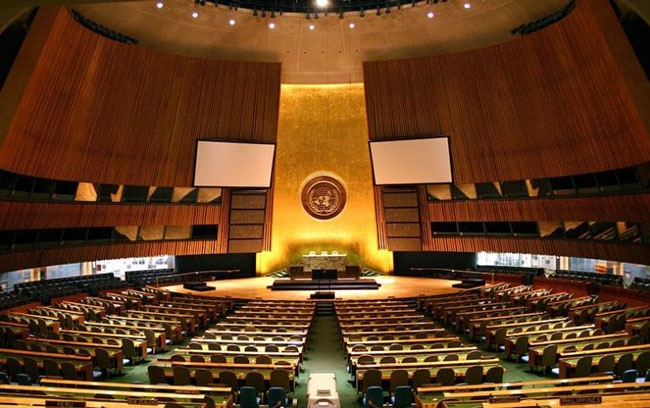
Vote on Indigenous Rights Declaration
[…] the Assembly adopted the United Nations Declaration on the Rights of Indigenous Peoples […]AJAI MALHOTRA (India) said his country had consistently favoured the promotion and protection of indigenous peoples’ rights. […]
Regarding references to the right to self-determination, it was his understanding that the right to self-determination applied only to peoples under foreign domination and that the concept did not apply to sovereign independent States or to a section of people or a nation, which was the essence of national integrity. The Declaration clarified that the right to self-determination would be exercised by indigenous peoples in terms of their right to autonomy or self-government in matters relating to their internal and local affairs, as well as means and ways for financing their autonomous functions. In addition, article 46 stated clearly that nothing in the Declaration might be interpreted as implying for any State, people, group or person any right to engage in any activity or to perform any act contrary to the Charter. It was on that basis that India had voted in favour of the adoption of the Declaration. […]
Source: UN Department of Public Information (New York, 13 September 2007)
http://www.un.org/News/Press/docs/2007/ga10612.doc.htm
Date Visited: 28 March 2011
Read more here: United Nations General Assembly: excerpts from the report on the 107th & 108th Meetings in 2007
This World Book Day, UNESCO promotes indigenous culture: Increasing awareness about indigenous tribes and languages through reading
Lisa Anthony, The Week, 23 April 2019 |For the full report, click here >>
The UNESCO has been committed to preserving the indigenous people of the world based on the Declaration of the Rights of the Indigenous People in September 2007. Undoubtedly, this initiative by the UNESCO is one of the purest and insightful ventures happening in the world right now and has become the perfect backdrop for the World Book Day this year. “Books are a form of cultural expression that lives through and as part of a chosen language. Each publication is created in a distinct language and is intended for a language-specific reading audience. A book is thus written, produced, exchanged, used and appreciated in a given linguistic and cultural setting. This year we highlight this important dimension because 2019 marks the International Year of Indigenous Languages, led by UNESCO, to reaffirm the commitment of the international community in supporting indigenous peoples to preserve their cultures, knowledge and rights,” says Audrey Azoulay, Director General of UNESCO.
It is estimated that there are around 370 million indigenous people in the world, scattered across 90 countries. Though huge, they have always symbolised the subaltern, who are always displaced from the modern society. Their inability or resistance towards mingling with the ordinary people of the world is probably even putting their longevity at stake.
In the fast-paced modern world, worrying about the indigenous groups seems an idea too distant for a layman. But that is where the role of reading comes into play. As pleasurable as it is, reading also brings along the exchange of culture, emotions, values and a lot more between the reader and the author. […]
With the current theme for the World Book Day this year, the UNESCO looks keen to improve reading skills among youngsters and incite awareness in the generation on the indigenous tribes and languages, on the verge of extinction.
Source: This World Book Day, UNESCO promotes indigenous culture, The Week
URL: https://www.theweek.in/leisure/society/2019/04/23/this-world-book-day-unesco-promotes-indigenous-culture.html
Date visited: 26 November 2019
[Bold typeface added above for emphasis]
“Many people – though not all – have been able to secure freedom from torture, unjustified imprisonment, summary execution, enforced disappearance, persecution and unjust discrimination, as well as fair access to education, economic opportunities, and adequate resources and health-care. They have obtained justice for wrongs, and national and international protection for their rights, through the strong architecture of the international human rights legal system.” – Introduction to the Universal Declaration of Human Rights, p.vi
See also: The Universal Declaration of Human Rights turns 70 | Human Rights Commission (posts) | National Human Rights Commission: www.nhrc.nic.in (Government of India) >>
Universal Declaration of Human Rights & Human Rights Day >>
The National Human Right Commission (NHRC) describes “crimes like rape, molestation, torture, fake encounter in police custody as manifestations of a systemic failure to protect human rights”;
It reports that “rights of the people were violated or negligence was shown by a public servant in the prevention of such violations”; NHRC concludes:
“Atrocities against vulnerable sections of society – women, children, disabled and the elderly – are often compounded when they belong to the Scheduled Castes and Scheduled Tribes”; and therefore demands:
India must ratify the International Convention against Torture.
Download | Backup (PDF, 500 KB) >>
“A call to action, resilience, and collective defence of democracy, truth, and academic freedom”
The Anti-Autocracy Handbook is a call to action, resilience, and collective defence of democracy, truth, and academic freedom in the face of mounting authoritarianism. […]
Because open inquiry and dissent are central to science and academia—qualities antithetical to authoritarian control—academia is often among the first targets of autocrats. To help scholars resist authoritarian developments, the handbook highlights both historic and contemporary measures aimed at attacking scholars, their institutional environments, and their scholarship.
The handbook also sets out a framework for action based on personal risk level—low, medium, high, or extreme. This is designed to help scholars think about their own risk and purposefully choose actions in line with it. The handbook considers tools for enhancing digital safety and highlights the importance of ongoing documentation, preserving imperilled data, and creating distributed archives as a defence against erasure. It also calls on scholars to tell their stories—publicly or anonymously—to inspire others, maintain accountability and preserve a historical record.
Accompanying the handbook is a living wiki that will continue to incorporate new developments and provide updates on global efforts by scholars to push back against authoritarianism and safeguard the democratic foundations that enable free inquiry.
Source: “The Anti-Autocracy Handbook: A Scholars’ Guide to Navigating Democratic Backsliding” by
URL: https://zenodo.org/records/15696097
Date Visited: 20 April 2026
Albert Camus on service of truth and the service of liberty – Nobelprize.org
Excerpt from Albert Camus’ speech at the Nobel Banquet at the City Hall in Stockholm, December 10, 1957 | Read the full speech: https://www.nobelprize.org/prizes/literature/1957/camus/speech/ >>
By the same token, the writer’s role is not free from difficult duties. By definition he cannot put himself today in the service of those who make history; he is at the service of those who suffer it. Otherwise, he will be alone and deprived of his art. Not all the armies of tyranny with their millions of men will free him from his isolation, even and particularly if he falls into step with them. But the silence of an unknown prisoner, abandoned to humiliations at the other end of the world, is enough to draw the writer out of his exile, at least whenever, in the midst of the privileges of freedom, he manages not to forget that silence, and to transmit it in order to make it resound by means of his art.
None of us is great enough for such a task. But in all circumstances of life, in obscurity or temporary fame, cast in the irons of tyranny or for a time free to express himself, the writer can win the heart of a living community that will justify him, on the one condition that he will accept to the limit of his abilities the two tasks that constitute the greatness of his craft: the service of truth and the service of liberty. Because his task is to unite the greatest possible number of people, his art must not compromise with lies and servitude which, wherever they rule, breed solitude. Whatever our personal weaknesses may be, the nobility of our craft will always be rooted in two commitments, difficult to maintain: the refusal to lie about what one knows and the resistance to oppression.
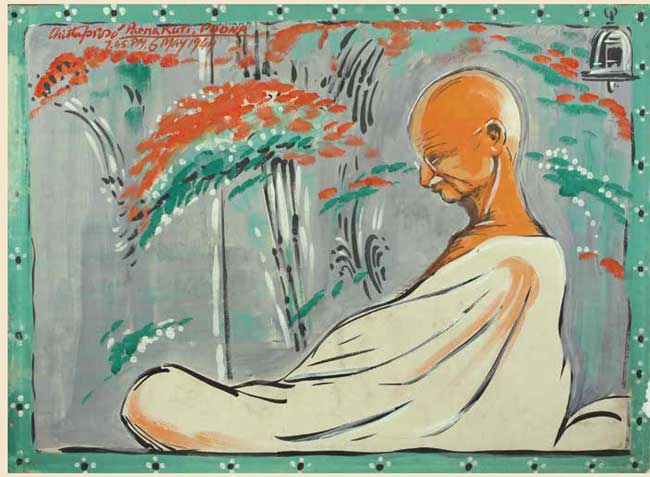
Gandhian social movement | Constitution | Adverse inclusion >>
Search Worldcat.org for publications by reputed authors (select “Open Content/Open Access” for freely downloadable content)
Search tips
Combine the name of any particular state, language or region with that of any tribal (Adivasi) community.
Ask a question that includes “tribal” or “Adivasi”, for instance: “Adivasi way of life better?” (or “tribal way of life worse?”)
Add keywords of special interest (music, poetry, dance just as health, sacred grove and biodiversity); learn about the rights of Scheduled Tribes such as the “Forest Rights Act” (FRA); and the United Nations “Declaration on the Rights of Indigenous Peoples”, “Universal Declaration of Human Rights”, “women’s rights”, or “children’s right to education”.
Specify any particular issue or news item (biodiversity, bonded labour and human trafficking, climate change, ecology, economic development, ethnobotany, ethnomedicine, global warming, hunter-gatherers in a particular region or state, prevention of rural poverty, water access).