View this slideshow and more: National Gallery >>
Related: Crafts and visual arts | Santiniketan | Tagore | Tribal identity >>
UNESCO World Heritage Centre >>
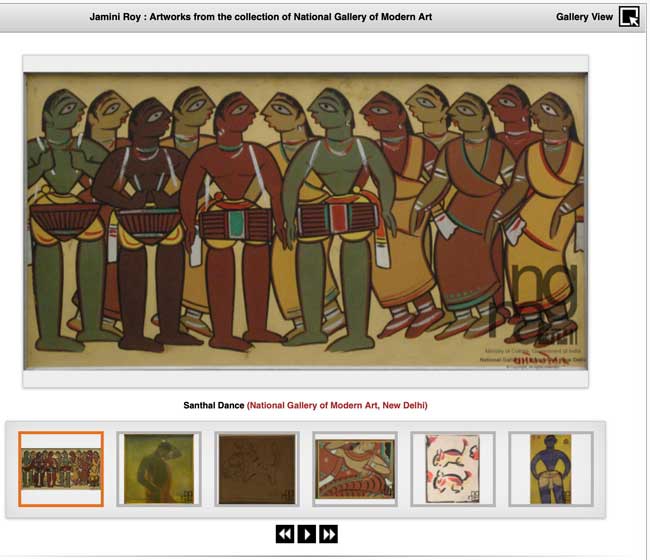
Jamini Roy was one of the earliest and most significant modernists of twentieth century Indian art. From 1920 onwards his search for the essence of form led him to experiment with dramatically different visual style. His career spanning over nearly six decades had many significant turning points and his works collectively speak of the nature of his modernism and the prominent role he played in breaking away from the art practices of his time. […]
In the first few years of the 1920s, Jamini Roy did several paintings in what he called “flat technique.” He had said that like Chinese landscapes, he discarded nonessential details in the backgrounds. The subjects were mostly Santhal women and he brought to the figuration a certain sensuousness. […]
The Bengal School, founded by Abanindranath Tagore and Kala Bhavana in Santiniketan under Nandalal Bose rejected European naturalism and the use of oil as a medium and were exploring new ways of representation. Jamini Roy, too, consciously rejected the style he had mastered during his academic training and from the early 1920s searched for forms that stirred the innermost recesses of his being. He sought inspiration from sources as diverse as East Asian calligraphy, terracotta temple friezes, objects from folk arts and crafts traditions and the like. […]
Screenshot: Santhal Dance by Jamini Roy
Source: National Portal and Digital Repository: Record Details
Address: http://museumsofindia.gov.in/repository/record/ngma_del-ngma-00158-19
Date Visited: Tue Nov 01 2016 20:06:18 GMT+0100 (CET)
Find educational and children’s books on tribal culture published in India – Custom search
List of sites covered by this Google SafeSearch engine
https://books.katha.org (Katha Books)
https://publicationsdivision.nic.in
Search tips
Combine the name of any particular state, language or region with that of any tribal (Adivasi) community.
Add keywords of special interest (music, poetry, dance just as health, sacred grove and biodiversity); learn about the rights of Scheduled Tribes such as the “Forest Rights Act” (FRA); and the United Nations “Declaration on the Rights of Indigenous Peoples”, “Universal Declaration of Human Rights”, “women’s rights”, or “children’s right to education”.
Ask a question that includes “tribal” or “Adivasi”, for instance: “Adivasi way of life better?” (or “tribal way of life worse?”)
Specify any particular issue or news item (biodiversity, bonded labour and human trafficking, climate change, ecology, economic development, ethnobotany, ethnomedicine, global warming, hunter-gatherers in a particular region or state, prevention of rural poverty, water access).
For official figures include “scheduled tribe ST” along with a union state or region: e.g. “Chhattisgarh ST community”, “Himalayan tribe”, “Scheduled tribe Tamil Nadu census”, “ST Kerala census”, “Particularly Vulnerable Tribal Group Jharkhand”, “PVTG Rajasthan”, “Adivasi ST Kerala”, “Adibasi ST West Bengal” etc.
SafeSearch browser tips
If your (mobile) browser fails to display “embedded” media contents, Google maps and SafeSearch windows
Try another browser like Firefox, Chrome or Safari available on your device
Ensure your favourite browser is up to date
Close your present browser
Check your browser and mobile (gsm) settings:
e.g. permission for video or JavaScript
(seen under Preferences >Security >Enable JavaSript)
Restart your computer (smartphone, tablet)
Reconnect to your wifi network or connect to a different one
On some iPhone models the following helps:
>Settings >Safari >scroll down to:
SETTING FOR WEBSITES
Enable “Request Desktop Website” (All Websites) temporarily
Return to the map-post in Safari and “Reload”
Return to >Settings and disable “Request Desktop Website” again
Return to the post in Safari and “Reload”which should now display “embedded” contents as intended (with the convenience of browsing the mobile version on a small screen)
Note: similar solutions may also work with other mobile operating systems.
More SafeSearch on this website
Search Worldcat.org for publications by reputed authors (select “Open Content/Open Access” for freely downloadable content)
Search tips
Combine the name of any particular state, language or region with that of any tribal (Adivasi) community.
Ask a question that includes “tribal” or “Adivasi”, for instance: “Adivasi way of life better?” (or “tribal way of life worse?”)
Add keywords of special interest (music, poetry, dance just as health, sacred grove and biodiversity); learn about the rights of Scheduled Tribes such as the “Forest Rights Act” (FRA); and the United Nations “Declaration on the Rights of Indigenous Peoples”, “Universal Declaration of Human Rights”, “women’s rights”, or “children’s right to education”.
Specify any particular issue or news item (biodiversity, bonded labour and human trafficking, climate change, ecology, economic development, ethnobotany, ethnomedicine, global warming, hunter-gatherers in a particular region or state, prevention of rural poverty, water access).