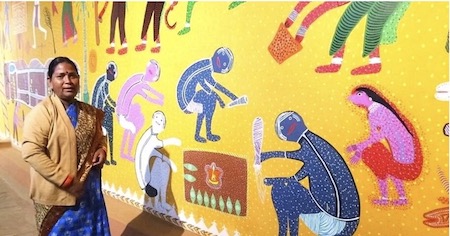
on © Thebetterindia.com >>
Madhya Pradesh-based Bhuri Bai has experienced acute poverty first hand and has also worked as a child labourer just to be able to afford one square meal. When she was 10, her house was burnt down in a fire, so her family built a makeshift house from hay and lived there for years. […]
Bhuri’s tale is worthy of a biopic and it begins in Jabhua’s rural landscape in the late 1960s. […]
The Jhabua district is home to the Bhil tribe, also referred to as the ‘brave bowmen of India’, who predominantly survived on forest resources in the 1800s. With time, agriculture became their main occupation. Surrounded by the Mahi river in the north and the Narmada in the south, this region is also the hub of ‘Pithora’, a spectacular ancient art form that is created on walls.
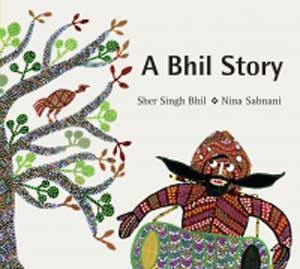
Childhood | Bhil art and culture >>
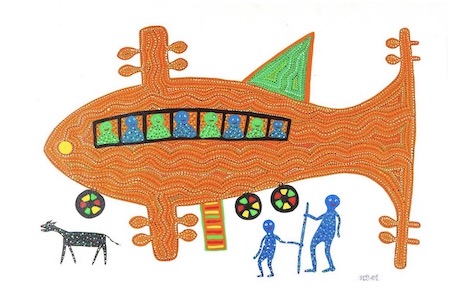
The Pithora paintings are soaked with religious and cultural significance. The paintings mainly use three lucky mascots of Bhilalala mythological stories — sun, moon and horses to creatively portray daily activities of rural life like hunting, ploughing and farming. The process of this indigenous painting begins with Lipai meaning covering the background of walls with cow dung, water and chuna. The walls are then embellished with birds, animals, trees in vivid colours. The selling point of Pithora is that no two paintings will ever be the same. Each artist uses their own creativity, imagination, patterns and colour combinations. […]
Bhuri is credited for being one of the pioneering women from her community who took forward the rich tribal lineage of Pithora paintings while creating livelihood opportunities in an otherwise region marred by infrastructural constraints. She has the distinction of seeing her art travelling to several art galleries in India and abroad. […]
More about the Bhil and Bhilala communities >>
Pithora arts and crafts >>
Source: “Padma Shri Artist From Madhya Pradesh Once Worked As A Daily Wager, Earning Rs 6” by Gopi Karelia, The Better India, 27 January 2021
URL: https://www.thebetterindia.com/247963/bhuri-bai-madhya-pradesh-padma-shri-2021-winner-pithora-paintings-inspiring-india-gop94/
Date Visited: 16 January 2022
[Bold typeface added above for emphasis]
Find educational and children’s books on tribal culture published in India – Custom search
List of sites covered by this Google SafeSearch engine
https://books.katha.org (Katha Books)
https://publicationsdivision.nic.in
Search tips
Combine the name of any particular state, language or region with that of any tribal (Adivasi) community.
Add keywords of special interest (music, poetry, dance just as health, sacred grove and biodiversity); learn about the rights of Scheduled Tribes such as the “Forest Rights Act” (FRA); and the United Nations “Declaration on the Rights of Indigenous Peoples”, “Universal Declaration of Human Rights”, “women’s rights”, or “children’s right to education”.
Ask a question that includes “tribal” or “Adivasi”, for instance: “Adivasi way of life better?” (or “tribal way of life worse?”)
Specify any particular issue or news item (biodiversity, bonded labour and human trafficking, climate change, ecology, economic development, ethnobotany, ethnomedicine, global warming, hunter-gatherers in a particular region or state, prevention of rural poverty, water access).
For official figures include “scheduled tribe ST” along with a union state or region: e.g. “Chhattisgarh ST community”, “Himalayan tribe”, “Scheduled tribe Tamil Nadu census”, “ST Kerala census”, “Particularly Vulnerable Tribal Group Jharkhand”, “PVTG Rajasthan”, “Adivasi ST Kerala”, “Adibasi ST West Bengal” etc.
SafeSearch browser tips
If your (mobile) browser fails to display “embedded” media contents, Google maps and SafeSearch windows
Try another browser like Firefox, Chrome or Safari available on your device
Ensure your favourite browser is up to date
Close your present browser
Check your browser and mobile (gsm) settings:
e.g. permission for video or JavaScript
(seen under Preferences >Security >Enable JavaSript)
Restart your computer (smartphone, tablet)
Reconnect to your wifi network or connect to a different one
On some iPhone models the following helps:
>Settings >Safari >scroll down to:
SETTING FOR WEBSITES
Enable “Request Desktop Website” (All Websites) temporarily
Return to the map-post in Safari and “Reload”
Return to >Settings and disable “Request Desktop Website” again
Return to the post in Safari and “Reload”which should now display “embedded” contents as intended (with the convenience of browsing the mobile version on a small screen)
Note: similar solutions may also work with other mobile operating systems.
More SafeSearch on this website
Tips for using interactive maps
Toggle to normal view (from reader view) should the interactive map not be displayed by your tablet, smartphone or pc browser
For details and hyperlinks click on the rectangular button (left on the map’s header)
Scroll and click on one of the markers for information of special interest
Explore India’s tribal cultural heritage with the help of another interactive map >>