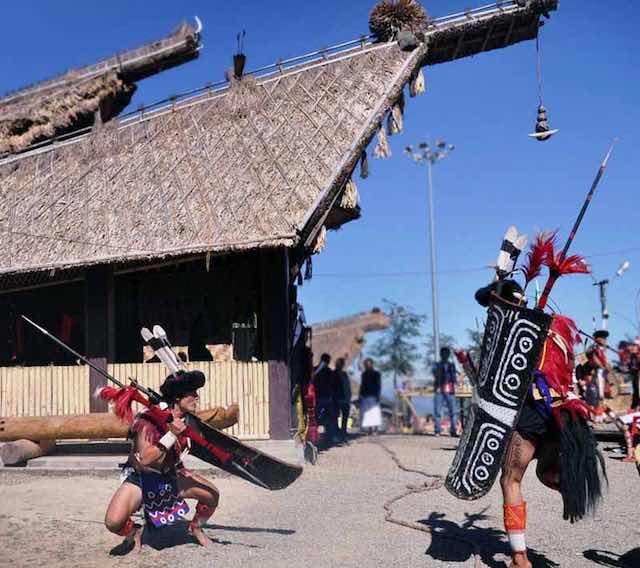
Nagaland has a rich linguistic tradition with as many languages as there are tribes, each exclusive to itself. The State is replete with festivities throughout the year, as all tribes celebrate their own festivals with a pageantry of colour, music and dance. A common feature is that the festivals revolve around agriculture, the mainstay of Naga economy. These festivals hark back to times prior to the advent of Christianity.
Most of these festivals revolve round agriculture, it being the main-stay of Naga society. Over 85% population of Nagaland is directly dependent on agriculture and lives in a thousand and odd villages situated on high hill tops or slopes overlooking verdant valleys humming with murmuring streams. In this blissful setting Nagas enjoy the blessing of Nature with rare gusto striking the onlookers with awe and admiration. In most of the places agriculture consists of monocrop. […]
List of tribal communities & festival calendar
Tribes of Nagaland 1. Angami 2. Ao 3. Chakhesang 4. Chang 5. Khiamniungan 6. Kuki 7. Konyak 8. Kachari 9. Lotha 10. Phom 11. Pochury 12. Rengma 13. Sumi 14. Sangtam 15. Tikhir 16. Yimkhiung 17. Zeliang Tribe – Name of festival – Date
1. Angami Sekrenyi 25 February Terhünyi 9 December 2. Ao Moatsu 2 May Tsungremmong 1-2 August 3. Chakhesang Sökrönye 15 January Tsukhenie 24 April 4. Chang Poang Lüm 13 January Kundaglün 1 April Naknyulüm 31 July 5. Khiamniungan Khaozaosie – Hok – Ah 20 January Biam 7 August Tsokum 5 October 6. Kuki Mimkut 17 January Chavang Kut 1 November 7. Konyak Aoleang 1- 2 April Lao – Ong Mo 28 September 8. Kachari Bishu 27 January 9. Lotha Tokhu Emong 6 – 7Novemebr 10. Phom Monyu 1 – 2 April 11. Pochury Yemshe 5 October 12. Rengma Ngada 27 – 28 November 13. Sumi Tuluni 8 July Apikimti 4 – 5 November Ahuna 14 – 15 November 14. Sangtam Tsohsu 12 March Hunapongpi 18 August Mongmong 3 September 15. Tikhir Kuhlang – Nyi 18 January Tsonglak-Nyi 9 October 16. Yimkhiung Wangtsunuo 16 April Metemneo 8 August 17. Zeliang Mileinyi 11 March Langsimnyi 31 October
Source: Official State Portal, Government of Nagaland
URL: https://nagaland.gov.in/pages/people-culture
Date Visited: 20 April 2025
Learn more about Naga tribes from kalpavriksh.org – Arunachal Pradesh, Assam, Manipur & Nagaland & Myanmar
There are sixteen major tribes inhabiting the state of Nagaland – the Angami, Ao, Lotha, Sumi, Chakesang, Chang, Kachari, Konyak, Khiamniungan, Kuki, Sangtam, Rengma, Phom, Yimchungru and Zeliang. The sixteen tribes are further divided into many subsections. However, there are around sixty Naga tribes inhabiting in Manipur, Assam, Arunachal Pradesh and Myanmar. Kohima is the capital of Nagaland, while Dimapur is the commercial with road, rail and air connectivity. [T]he state of Nagaland lies within the Indo-Myanmar Biodiversity hotspot, and illustrates unique a rich biodiversity of endemic flora and fauna, of which many are considered rare and endangered. In acknowledgement of the importance of the natural resources, the communities of Nagaland work together to protect and conserve their biodiversity, which resulted in the formation of the many Community Conserved Areas (CCAs) in the state.
Source: “About Nagaland” (PDF, 100 KB) by kalpavriksh.org | Backup | Resources for educators
URL: https://kalpavriksh.org/wp-content/uploads/2024/08/NCCAF-Meet-2024.pdf
Date Visited: 29 April 2025
More from & about Kalpavriksh on the present website >>
Up-to-date reports by Indian experts and journalists
List of sites covered by this Google SafeSearch engine
Academia.edu (platform for academics to share research papers) – www.academia.edu
Archive.org – https://archive.org
Centre for Science and Environment – https://www.cseindia.org
Current Conservation – https://www.currentconservation.org
Development and Cooperation (D+C) https://www.dandc.eu
Down To Earth (India) – www.downtoearth.org.in
India Environment Portal – www.indiaenvironmentportal.org.in
Harnessing Nature Magazine – https://harnessingnature.online
Kalpavriksh Environmental Action Group – https://kalpavriksh.org
Mongabay-India – https://india.mongabay.com
M S Swaminathan Research Foundation – www.mssrf.org
Navdanya (protecting India’s biodiversity based food heritage) – https://navdanya.org
People’s Archive of Rural India – https://ruralindiaonline.org/
Third World Network (Penang, Malaysia) – https://twn.my
The Shola Trust (nature conservation in the Nilgiri region) – www.thesholatrust.org
TribalConnect (“uplift and benefit the community without adversely affecting or changing their vernacular”) – https://tribalconnect.org.in
WorldCat (“the world’s largest library catalog, helping you find library materials online”) – https://worldcat.org
More SafeSearch on this website
Search tips
Combine the name of any particular state, language or region with that of any tribal (Adivasi) community.
Add keywords of special interest (music, poetry, dance just as health, sacred grove and biodiversity); learn about the rights of Scheduled Tribes such as the “Forest Rights Act” (FRA); and the United Nations “Declaration on the Rights of Indigenous Peoples”, “Universal Declaration of Human Rights”, “women’s rights”, or “children’s right to education”.
Ask a question that includes “tribal” or “Adivasi”, for instance: “Adivasi way of life better?” (or “tribal way of life worse?”)
Specify any particular issue or news item (biodiversity, bonded labour and human trafficking, climate change, ecology, economic development, ethnobotany, ethnomedicine, global warming, hunter-gatherers in a particular region or state, prevention of rural poverty, water access).
For official figures include “scheduled tribe ST” along with a union state or region: e.g. “Chhattisgarh ST community”, “Himalayan tribe”, “Scheduled tribe Tamil Nadu census”, “ST Kerala census”, “Particularly Vulnerable Tribal Group Jharkhand”, “PVTG Rajasthan”, “Adivasi ST Kerala”, “Adibasi ST West Bengal” etc.
SafeSearch browser tips
If your (mobile) browser fails to display “embedded” media contents, Google maps and SafeSearch windows
Try another browser like Firefox, Chrome or Safari available on your device
Ensure your favourite browser is up to date
Close your present browser
Check your browser and mobile (gsm) settings:
e.g. permission for video or JavaScript
(seen under Preferences >Security >Enable JavaSript)
Restart your computer (smartphone, tablet)
Reconnect to your wifi network or connect to a different one
On some iPhone models the following helps:
>Settings >Safari >scroll down to:
SETTING FOR WEBSITES
Enable “Request Desktop Website” (All Websites) temporarily
Return to the map-post in Safari and “Reload”
Return to >Settings and disable “Request Desktop Website” again
Return to the post in Safari and “Reload”which should now display “embedded” contents as intended (with the convenience of browsing the mobile version on a small screen)
Note: similar solutions may also work with other mobile operating systems.
What does it mean to be Indigenous?
Indigenous Peoples can be identified according to certain characteristics:
They are politically and socially marginalized.
Most importantly, they self-identify as Indigenous Peoples.
They share an ancestral link with those who inhabited a country or region before they were colonized or before other peoples became dominant.
They have a strong link to particular territories and the surrounding natural resources.
They have distinct social, economic or political systems, which they are resolved to maintain and reproduce.
They have a distinct language, culture and beliefs.
There are more than 5,000 different Indigenous Peoples around the world comprising 476 million people – around 6.2% of the global population. They are spread across more than 90 countries in every region and speak more than 4,000 languages. | Learn more (Amnesty International) >>
Source: “INDIGENOUS PEOPLES’ RIGHTS” by Amnesty International
URL: https://www.amnesty.org/en/what-we-do/indigenous-peoples/
Date Visited: 10 May 2025
Learn more on the Rights of Indigenous Peoples, their Languages & linguistic heritage & Tribal culture worldwide >>
Tips for using interactive maps
Toggle to normal view (from reader view) should the interactive map not be displayed by your tablet, smartphone or pc browser
For details and hyperlinks click on the rectangular button (left on the map’s header)
Scroll and click on one of the markers for information of special interest
Explore India’s tribal cultural heritage with the help of another interactive map >>