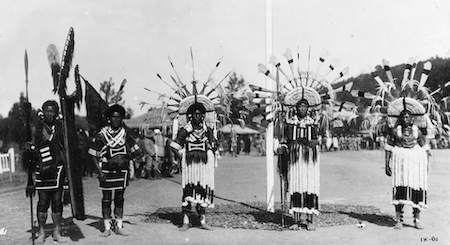
Listen to all items from the playlist >>
This research project, led by Dr. Christian Poske, is a collaborative effort involving the Pitt Rivers Museum, the Archives and Research Center for Ethnomusicology (ARCE), and the Highland Institute in Kohima, targeting the recirculation of the cylinder recordings of John Henry Hutton (1885-1968) in Nagaland. | Learn more >>
Source: “Recirculating sound recordings in NE India”
URL: https://www.prm.ox.ac.uk/recirculating-sound-recordings-in-ne-india
Date Visited: 30 April 2025
Hutton was a British colonial administrator and anthropologist working for the Indian Civil Service from 1909 to 1936 in the Assam province, which incorporated the territory of Nagaland of present-day India. During his early service, he made fifteen cylinder recordings (*) in the Nagaland region, featuring ritual songs, work songs, and other pieces performed by members of different Naga communities. Hutton donated the cylinders to the Pitt Rivers Museum between 1915-19. Only twelve of the fifteen cylinder recordings were copied to reel-to-reel tape at the National Sound Archive in London in 1987, as sound engineers found three cylinders irreparably broken. Today, the fifteen cylinders are at the Pitt Rivers Museum, and a selection of the twelve digitized recordings are accessible on its website for listening.| Learn more >>
(*) The Hutton collection of the Pitt Rivers Museum actually comprises 14 cylinders; the project blogs will be updated soon. Email by Christian Poske, 23.4.2022.
Source: “Recirculating J. H. Hutton’s Cylinder Recordings in Nagaland” by Dr. Christian Poske
URL: https://highlandinstitute.org/2021/11/18/re-circulating-j-h-huttons-cylinder-recordings-in-nagaland/
Date Visited: 19 March 2022
John Henry Hutton (1885–1968) was born in Yorkshire and educated at Worcester College, Oxford. In 1909 he joined the Indian Civil Service and spent most of his administrative career in Assam, on the border between India and Burma, particularly in the Naga Hills, where he worked as both a Political Officer and Deputy Commissioner. […]
Hutton was a prolific collector of Naga material culture, much of which was donated to the Pitt Rivers Museum, along with a significant collection of photographs. He also published several books on different Naga groups, such as the Angami and Sema. […]
The Recordings
Hutton’s collection of 15 wax cylinders were all recorded during his fieldwork in the Naga Hills, Assam, India between 1914 and 1916. They include examples of songs from the Angami, the Chang, the Sangtam, the Sema and the Lhota Naga. Twelve of the 15 cylinders were digitised by engineers at the British Library in 1987, and three cylinders were broken and could not be transferred. The collection includes several different types of song, including wedding songs, songs sung for sacrifice after a harvest festival, and courting songs sung by a quartette of men and women. Hutton’s documentation for several of the songs includes full lyrics in Naga and named individual singers.| Learn more >>
Source: “The John Henry Hutton Archive”
URL: https://web.prm.ox.ac.uk/reel2real/index.php/collections-hutton.html
Date Visited: 19 March 2022
Learn more about Naga tribes from kalpavriksh.org – Arunachal Pradesh, Assam, Manipur & Nagaland & Myanmar
There are sixteen major tribes inhabiting the state of Nagaland – the Angami, Ao, Lotha, Sumi, Chakesang, Chang, Kachari, Konyak, Khiamniungan, Kuki, Sangtam, Rengma, Phom, Yimchungru and Zeliang. The sixteen tribes are further divided into many subsections. However, there are around sixty Naga tribes inhabiting in Manipur, Assam, Arunachal Pradesh and Myanmar. Kohima is the capital of Nagaland, while Dimapur is the commercial with road, rail and air connectivity. [T]he state of Nagaland lies within the Indo-Myanmar Biodiversity hotspot, and illustrates unique a rich biodiversity of endemic flora and fauna, of which many are considered rare and endangered. In acknowledgement of the importance of the natural resources, the communities of Nagaland work together to protect and conserve their biodiversity, which resulted in the formation of the many Community Conserved Areas (CCAs) in the state.
Source: “About Nagaland” (PDF, 100 KB) by kalpavriksh.org | Backup | Resources for educators
URL: https://kalpavriksh.org/wp-content/uploads/2024/08/NCCAF-Meet-2024.pdf
Date Visited: 29 April 2025
More from & about Kalpavriksh on the present website >>
[Bold typeface added above for emphasis]
As the mighty river flows, so does the natural music of the pain of environmental change. […] Songs have always chronicled social, political, historic, geographical, cultural and environmental change. Many popular singers have responded to the climate crisis. | The Changing Climate In The Songs Of The Brahmaputra (The Wire) | United Nations on climate change >> >>
Up-to-date reports by Indian journalists and commentators
To search Indian periodicals, magazines, web portals and other sources safely, click here. To find an Indian PhD thesis on a particular tribal community, region and related issues, click here >>
Search Worldcat.org for publications by reputed authors (select “Open Content/Open Access” for freely downloadable content)
Search tips
Combine the name of any particular state, language or region with that of any tribal (Adivasi) community.
Ask a question that includes “tribal” or “Adivasi”, for instance: “Adivasi way of life better?” (or “tribal way of life worse?”)
Add keywords of special interest (music, poetry, dance just as health, sacred grove and biodiversity); learn about the rights of Scheduled Tribes such as the “Forest Rights Act” (FRA); and the United Nations “Declaration on the Rights of Indigenous Peoples”, “Universal Declaration of Human Rights”, “women’s rights”, or “children’s right to education”.
Specify any particular issue or news item (biodiversity, bonded labour and human trafficking, climate change, ecology, economic development, ethnobotany, ethnomedicine, global warming, hunter-gatherers in a particular region or state, prevention of rural poverty, water access).
Tips for using interactive maps
Toggle to normal view (from reader view) should the interactive map not be displayed by your tablet, smartphone or pc browser
For details and hyperlinks click on the rectangular button (left on the map’s header)
Scroll and click on one of the markers for information of special interest
Explore India’s tribal cultural heritage with the help of another interactive map >>