“Our boys and girls get an opportunity to set their eyes upon each other during the dance of the Dandari. They also get to interact a little before they can mutually agree to take the matter to the next step. […] As per our customs and traditions the youngsters enjoy liberty in many aspects. It is rare that a selection made during the Dandari-Ghusadi [dance festival] phase gets cancelled.” – Patel of Bandeyer Atram Sone Rao (Telangana), quoted in “Adivasis dance their way to a girl’s heart” (The Hindu, 29 October 2016)
https://www.thehindu.com/news/national/telangana/Adivasis-dance-their-way-to-a-girl’s-heart/article16085049.ece
https://indiantribalheritage.org/?p=22436
The Hindu, NELLORE, February 5, 2015 A well-planned ‘Girijan Utsav’, a festival of tribal people living in hill forests, is considered as the best proposition to bring together the different tribes and keep alive their traditions at Penchalakona hill region in Nellore district. Considering the historical significance of Penusila Narasimha Swamy Temple and the legend surrounding … Read more
SHAILAJA TRIPATHI, The Hindu, April 23, 2015 “An extensive exhibition of Santhal music explores the changing face of the distinct tradition and why we need to restore it to its original form” The exhibition at the National Museum till May 17 On 15 April 2015 the exhibition “Cadence and Counterpoint: Documenting Santal Musical Traditions” was … Read more
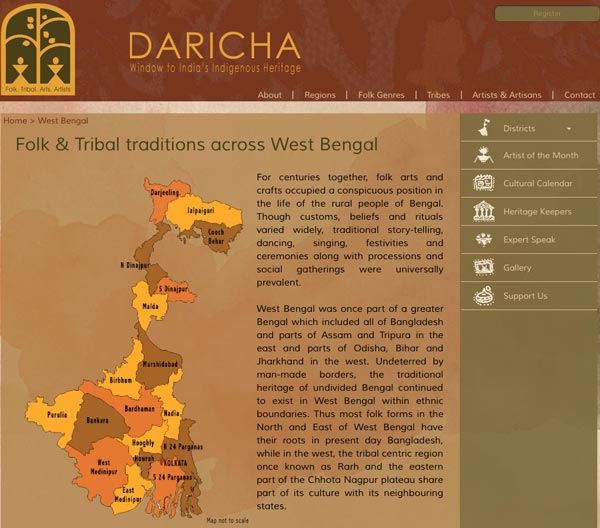
For centuries together, folk arts and crafts occupied a conspicuous position in the life of the rural people of Bengal. Though customs, beliefs and rituals varied widely, traditional story-telling, dancing, singing, festivities and ceremonies along with processions and social gatherings were universally prevalent.
West Bengal was once part of a greater Bengal which included all of Bangladesh and parts of Assam and Tripura in the east and parts of Odisha, Bihar and Jharkhand in the west. | To read the full article and view a series of photos, click here >>
Find more resources by typing “Daricha Foundation”, “Bengal folk culture”, “Bengal tribal craft”, “Bangladesh tribal heritage”, “Assam tribal custom”, “Tripura tribal culture” or any combination of keywords on related projects across India here: Search select periodicals >>
To read the full story and view more photos, click here >>
‘Pawari’, is a traditional instrument of the Dangis. It has been regularly used in all the prominent functions and festivals in Dang. In Dhule of Maharashtra, Pawari has been used mainly in weddings. But in Dang, it is frequently used, especially in the Dang Durbar, a spectacular annual festival held in the district for three days during Holi. Today, however, only a very few individuals play it.
The Pawari is made of wood obtained from locally grown trees, with a beak like structure attached and painted in bright blue-silver combination. […]
Each tune emerging from the instrument resembled some instrument – Indian, European and host of other things we could not identify. Ramdas boasted that his father had played it in all of the tribal festivals and annual celebrations around the totems. He was then speaking about the essential tribal culture which he took pride in, without realizing that minutes ago he was all praise for the Hindutva which had treated the tribals as Rakshasas and Kirathakas.
(I came across this instrument, Pawari, during my field visits in an internship with Centre for Social Justice (June 2013). It is an organization that is primarily working for the welfare of the tribals in Dang district, Gujarat.)
Public access to PARI is free. The site is run by The CounterMedia Trust. A more informal body, the CounterMedia Network, supports and funds the Trust and its primary activity through membership fees, volunteer work, donations, and direct personal contributions. This voluntary network of reporters, professional filmmakers, film editors, photographers, documentary makers, television, online and print journalists, represents PARI’s biggest asset. Besides, academics, teachers, researchers, techies and professionals from many other fields have also donated their expertise free of charge to establish the entity and design the site. PARI will need money to create content beyond what we can get done free, and will aim at crowdsourcing for that. Rural India can never be fully ‘captured’ and the content up on this site consists of fragments of many giant realities. We can expand our coverage of those many worlds only with the widest possible public participation.
SAPUTARA Gujarat’s only hill station offers a welcome respite from urban greyness
[…] We reached the entrance to Saputara, 1,000 metres above sea level, the only hill station of Gujarat. The district, Dang, is predominantly tribal. Music from an instrument called the ‘pavrivadan’, made out of bottle gourd, welcomed us. Hindu mythology says that Lord Ram spent 11 years of exile in the dense forests of Saputara; the story of the woman feeding jujube to Ram is rooted to a place called Shabridham, about 80 kms from here. There is a statue of a serpent deity on the banks of the river Sarpaganga, who’s worshipped by the local tribals. Saputara has a lake in the middle of the hills. […]
Baha The Baha Parab is the Flower Festival of the Santals, celebrated in the beginning of spring. The ritual observed revolves around man’s communion with nature and the celebration of beauty. The Naike (Santal priest) and other villagers offer a Sal flower to every family of the village. A Santal woman receives flowers in … Read more