Listen to David Suzuki’s Survival Guide | Naked Ape to Superspecies >>
“Forget it […] even if we could bring all the species back to life we don’t know enough about the ecosystems to bring them back together – it would be like unscrambling an egg blindfolded, with a spoon.” – Biologist, naturalist, ecologist, and entomologist E.O. Wilson (“known for developing the field of sociobiology”) interviewed by David Suzuki in Ideas with Nahlah Ayed – Aug. 1, 2023 [34:50]
Wilson coined the phrase scientific humanism as “the only worldview compatible with science’s growing knowledge of the real world and the laws of nature”. Wilson argued that it is best suited to improve the human condition. In 2003, he was one of the signers of the Humanist Manifesto.
“Scientific humanism” in Wikipedia entry on E.O. Wilson (Date Accessed: 5 August 2023)
Never before in the four billion-year history of life on Earth has a single species been able to alter the geological, biological and physical features of the planet. As David Suzuki puts it, “We have evolved from naked ape to superspecies.” This first episode from his 1999 IDEAS series, The Naked Ape, explores the impact of human culture on the natural world. […]
He once said: “The future doesn’t exist. The only thing that exists is now, and our memory of what happened in the past. But because we invented the idea of a future, we’re the only animal that realized we can affect the future by what we do today.”
A world-renowned environmental activist, science communicator and broadcaster who has been at the forefront of environmentalism for more than five decades, Suzuki has devoted his life to educating people about the importance of preserving the environment and its ecosystems.
David Suzuki is best known as the host of CBC’s The Nature of Things, the longest-running science documentary series in the world. He has also authored over 40 books on topics like climate change, clean energy and sustainability. It’s safe to say that Suzuki is an authoritative voice on environmental issues in Canada and around the world.
[Bold typeface added above for emphasis]
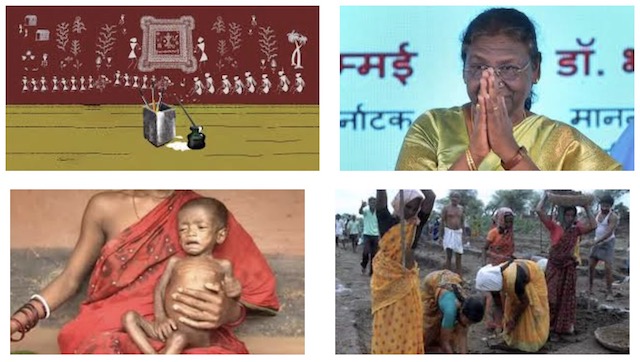
linked to each other.” – Droupadi Murmu | Speeches by the President of India >>
Images © publishers, artists & photographers featured by Google Safe Search
Learn more about water-related issues that affect India’s tribal communities >>
“Together, we must endeavour to strengthen tribal communities which are the role model in preservation of water, forest and land, and learn from their connection with nature and the surrounding environment for the sake of the entire human race.” – journalist and tribal rights activist Dayamani Barla in The Wire >>
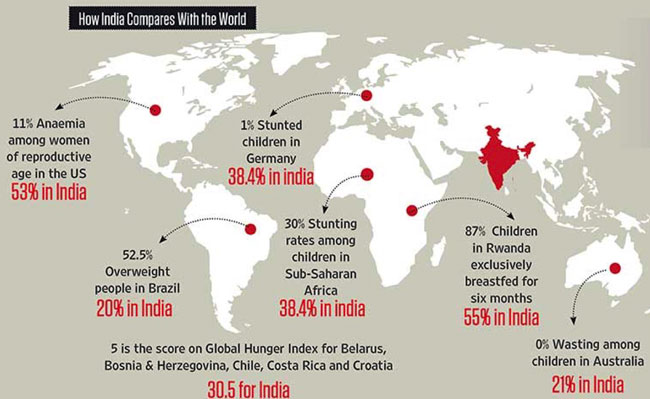
Graphic © Outlook India 26 August 2019 >>
The tribal food basket has always been diverse and nutritious >>
Childrens rights: UNICEF India | Childrens right to education >>
Health spending by the Indian government
“Health spending by the Indian government as percentage of GDP has long been one of the lowest for any major country, and the public health system is chronically dismal.” – Pranab Bardhan in “The two largest democracies in the world are the sickest now” | Learn more: Scroll.in, 24 August 2020 >>
Context | Health care for communities identified as “poorest of poor” (PVTGs)
India is designated as the melting pot of so many ethnic groups dwelling at the same time under the common umbrella of a unified nation. Among these varied ethnic groups, some of them have been categorized under article 342 (1) of the constitution and have been labelled as Scheduled Tribe. In the post independent scenario, several schemes for upliftment of STs were run by the government but it was found that all these groups did not come up to the same level of development. Some of them were at much lower strata than others. Thus, in order to ensure the development of these communities, they were, for the first time in 1975-76 (during 5th Five-year plan) and thereafter-in 1993, identified as poorest of poor among the STs and were designated as Primitive Tribal Groups and thereafter constitution of India renamed and declared as Particularly Vulnerable Tribal Groups (PVTGs). Out of the 75 particularly vulnerable tribal groups, 13 are residing in Odisha; they are becoming increasing vulnerable due to loss of their customary habitat. The health troubles of rural areas especially in the tribal areas need a unique concentration, because the tribal people have typical health problem.
Source: 2019 PhD thesis (Abstract) by Jayanta Kumar Nayak titled “Health Seeking Behaviour and Health Care Services among the Hill Kharia Mayurbhanj District Odisha”, Department of Anthropology, Central University of Orissa
URL: http://hdl.handle.net/10603/257651
Date Visited: 21 May 2025
Factchecker.in | Safe search examples with keywords:
“tribal rights unesco“ | “rural india unesco“ | “tribal education india unesco“
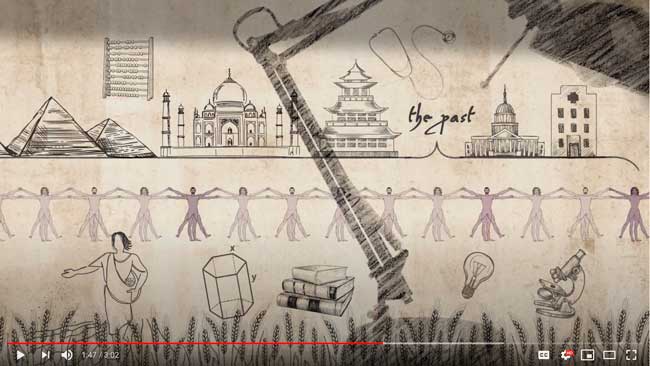
Watch “The Good Ancestor – The Legacies We Leave” (3 min.): An animation that explores the legacies we might leave for future generations >>
Links to some of the most important organisations, thinkers and doers that are leading the way and that have inspired the book The Good Ancestor by Roman Krznaric >>
Facts and figures: India’s biological, cultural and geographic diversity
Spread over 3,287,240 km2 and despite a total human population of over 1,210,000,000, India represents a wide spectrum of biological, cultural and geographic diversity. It has been identified as one of the top 12 global biodiversity hotspots and has 91 eco-cultural zones inhabited by 4,635 ethnic communities. India also has amongst the largest indigenous/tribal population, constituting 8.08% of the country’s population, representing 461 tribes. The term ‘Indigenous Peoples’ is not officially recognized in the country, instead the Constitution of India uses the term ‘Scheduled Tribes’. The total forest cover is estimated to be approximately 20% of the total area of the country. About 1,70,379 villages with a population of 10,674,334 inhabit areas in close proximity of forests.
Source: RECOGNITION AND SUPPORT OF ICCAs IN INDIA by Neema Pathak Broome and Tushar Dash, p. 4 | PDF-Repository
URL: https://kalpavriksh.org/wp-content/uploads/2021/01/IndiaICCARecognition_Final_SEPT2012-as-published.pdf
Date Visited: 10 March 2025
See also
Accordweb.in | Accord | Articles by co-founder Mari Marcel Thekaekara | Shola Trust
Atree.org | Ashoka Trust for Research in Ecology & the Environment (posts)
Climate change | Audio | The Climate Question (BBC Podcast)
Environmental history and what makes for a civilization – Romila Thapar
Equations blog (Equitable Tourism Options)
Information provided by Indian government agencies and other organizations (FAQ)
Nature and wildlife | Crocodile | Elephant | Tiger | Mangrove forest | Trees
PARI’s tales from tiger territory | People’s Archive of Rural India (PARI)
United Nations on climate change
What is the Forest Rights Act about?
Who is a forest dweller under this law, and who gets rights?