United Nations call for a victim-centred approach
This year’s campaign highlights the vital role of law enforcement and the criminal justice system in dismantling organized trafficking networks while ensuring a victim-centred approach.
Human trafficking continues to be a global threat driven by organized crime. More and more victims are being trafficked every year, across greater distances, with greater violence, for longer periods of time and for greater profit. From 2020 to 2023, there were more than 200,000 detected victims globally, which is just the tip of the iceberg. The actual number of unreported cases is believed to be significantly higher. […]
Despite some progress, criminal justice responses remain inadequate in tackling this rapidly evolving crime. To end human trafficking, law enforcement must enforce strict laws, conduct proactive investigations, strengthen cross-border cooperation, target criminal finances, and leverage technology to identify and dismantle trafficking networks. Ensuring justice for survivors requires holding perpetrators accountable and providing a victim-centred approach to protection, support and access to justice. […]
Your active involvement bridges the gap between the campaign’s global reach and local realities, ensuring it effectively connects with those impacted by human trafficking.
Source: Theme 2025: “Human trafficking is Organized Crime – End the Exploitation” by United Nations Office on Drugs and Crime
URL: https://www.unodc.org/unodc/en/endht/index.html
Date Visited: 25 May 2025
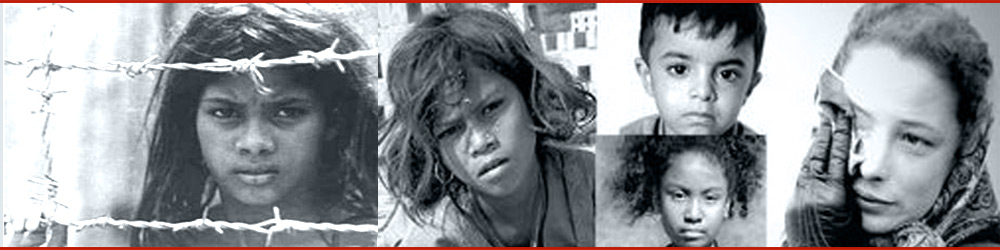
Human trafficking | Violence against women
Slavery | Zamindari
Human trafficking is a crime. To report in India, contact
Shakti Vahini https://shaktivahini.org/contact-us >> shaktivahini@gmail.com
+91-9899710847 +91-9582909025
and/or Childline 1098 (national helpline)
National Programme for Child Labour Free India | PDF-Repository (70 KB)
“Child marriage is not just an age-old social evil, but also a heinous crime that robs children of their childhood. Child marriage is a “crime against children” that violates basic human rights, minor girls are forced to marry and live a life of mental trauma, physical and biological stress, domestic violence including limited access to education and increased vulnerability to domestic violence. […] early pregnancies leading to complications and higher rate of maternal mortality and death of infants, malnutrition.” – Shakti Vahini’s campaign for a Child Marriage Free India >>
“As per a study on human trafficking, the state of Jharkhand has emerged as India’s trafficking hub with thousands of tribal women and girls being trafficked out of the state each year to Delhi, Punjab, Haryana and beyond [while] human traffickers are also involved in many cases of missing children.” – The Wire | Shakti Vahini | Tourism locations | Adivasi tribal bondage slavery trafficking (Safe search) >>
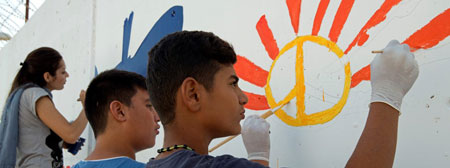
International Day of the World’s Indigenous People (9 August) >>
World Day Against Trafficking in Persons 30 July
The stories of human trafficking survivors illustrate the impact of survivor engagement and the need for victim empowerment – each story shows the motivation to engage in anti-trafficking efforts. Many victims of human trafficking have experienced ignorance or misunderstanding in their attempts to get help.| Learn more >>
Find up-to-date information provided by, for and about Indian authors, researchers, officials, and educators
List of sites covered by this Google SafeSearch engine
Ashoka Trust for Research in Ecology and the Environment (ATREE) – www.atree.org
Freedom United – www.freedomunited.org
Government of India (all websites ending on “.gov.in”)
Kalpavriksh Environmental Action Group – https://kalpavriksh.org
Shodhganga (a reservoir of Indian theses) – https://shodhganga.inflibnet.ac.in
Survival International – www.survivalinternational.org
UCLA Digital Library – https://digital.library.ucla.edu
Unesco – https://en.unesco.org
Unesco digital library – https://unesdoc.unesco.org
Unicef – www.unicef.org
United Nations – www.un.org/en
Video Volunteers – www.videovolunteers.org
WorldCat (“the world’s largest library catalog, helping you find library materials online”) – https://worldcat.org
Search tips
Combine the name of any particular state, language or region with that of any tribal (Adivasi) community.
Add keywords of special interest (music, poetry, dance just as health, sacred grove and biodiversity); learn about the rights of Scheduled Tribes such as the “Forest Rights Act” (FRA); and the United Nations “Declaration on the Rights of Indigenous Peoples”, “Universal Declaration of Human Rights”, “women’s rights”, or “children’s right to education”.
Ask a question that includes “tribal” or “Adivasi”, for instance: “Adivasi way of life better?” (or “tribal way of life worse?”)
Specify any particular issue or news item (biodiversity, bonded labour and human trafficking, climate change, ecology, economic development, ethnobotany, ethnomedicine, global warming, hunter-gatherers in a particular region or state, prevention of rural poverty, water access).
For official figures include “scheduled tribe ST” along with a union state or region: e.g. “Chhattisgarh ST community”, “Himalayan tribe”, “Scheduled tribe Tamil Nadu census”, “ST Kerala census”, “Particularly Vulnerable Tribal Group Jharkhand”, “PVTG Rajasthan”, “Adivasi ST Kerala”, “Adibasi ST West Bengal” etc.
SafeSearch browser tips
If your (mobile) browser fails to display “embedded” media contents, Google maps and SafeSearch windows
Try another browser like Firefox, Chrome or Safari available on your device
Ensure your favourite browser is up to date
Close your present browser
Check your browser and mobile (gsm) settings:
e.g. permission for video or JavaScript
(seen under Preferences >Security >Enable JavaSript)
Restart your computer (smartphone, tablet)
Reconnect to your wifi network or connect to a different one
On some iPhone models the following helps:
>Settings >Safari >scroll down to:
SETTING FOR WEBSITES
Enable “Request Desktop Website” (All Websites) temporarily
Return to the map-post in Safari and “Reload”
Return to >Settings and disable “Request Desktop Website” again
Return to the post in Safari and “Reload”which should now display “embedded” contents as intended (with the convenience of browsing the mobile version on a small screen)
Note: similar solutions may also work with other mobile operating systems.
“In his play Muktadhara (The Waterfall), Tagore robustly employs this element of freedom. The play relates the story of an exploited people and their eventual release from it. [Today, when] tribal populations across India are being uprooted with impudence Tagore’s message of freedom, in all its shades, is of utmost relevance.” – Bhaswati Ghosh in Freedom in Tagore’s Plays | Learn more >>
MODERN SLAVERY IN INDIA >>
Estimated number living in modern slavery: 11,050,000 (8.0 per thousand)
“Modern slavery takes many forms and is known by many names. Essentially, it refers to situations of exploitation that a person cannot refuse or leave because of threats, violence, coercion, or deception. […] Modern slavery is inextricably linked with global challenges such as climate degradation, gender inequality, COVID-19, and conflict. […] The adverse impacts of climate change magnify other drivers of displacement such as loss of livelihoods, poverty, food insecurity, and a lack of access to water and other resources, pushing people to migrate and exposing these vulnerable populations to modern slavery. […] An estimated 5.4 million children worldwide live in orphanages and other institutions.” – https://www.walkfree.org/global-slavery-index/ (Date accessed: 11 April 2024)
WOMEN AND GIRLS
Women and girls are disproportionately affected by modern slavery. As they transition through childhood, adolescence and adult life, the impacts of discrimination multiply and gender inequality grows.
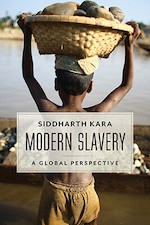
Video lessons on Human trafficking >>
Tip: check the latest figures and reports published by the Walk Free Foundation >>
Walk Free uses cutting-edge prevalence estimation techniques including nationally-representative surveys in partnership with Gallup, risk-model extrapolation and multiple systems estimation to measure modern slavery globally. We also assess government responses to this issue and vulnerability structures that impact populations around the world >>
Hundreds of millions of people today are highly impoverished and disadvantaged by virtue of ethnic or gender identity. These and other forces render them highly vulnerable to false offers by human traffickers. […] In fact, we still do not know to what extent global supply chains are maintained by slavery and child labor. Because of these and other factors, slavery today is more profitable than ever before, and also more woven into the global economy than ever before.
Source: Siddharth Kara interviewed by Katie Gibsoni: Quick, cheap and vulnerable: Siddharth Kara on the persistence of modern slavery, 12 October 2017, Harvard Kennedy School (Faculty and Research)
Date accessed: 6 May 2023
URL: https://www.hks.harvard.edu/research-insights/policy-topics/human-rights/siddharth-kara-persistence-modern-slavery
Siddharth Kara, Director of the Program on Human Trafficking and Modern Slavery at Harvard Kennedy School and author of three books: “Bonded Labor: Tackling the System of Slavery in South Asia”; “Modern Slavery,” and “Sex Trafficking: Inside the Business of Modern Slavery” | Read the full interview titled “Quick, cheap and vulnerable: Siddharth Kara on the persistence of modern slavery” >>
“The transformation of the global slave trade from a high-cost, slow-recruitment business to a low-cost, rapid-recruitment one is driving criminal interest in trafficking and slavery, which is why it is permeating every corner of the global economy. […] For the past quarter of a century, the global economy has brought many benefits to the world through greater flows in goods, capital and people. But the poorest of the poor have increasingly become an exploited labour class toiling in murky factories, mines and fields to feed our insatiable appetites. In this way, we are all shareholders in a system of slavery found in numerous global supply chains. We must ask ourselves how much longer we will look the other way while millions toil in slave-like conditions to provide us with the goods and services we consume.” – Siddharth Kara | Read more and watch a video interview with Siddharth Kara published by The Guardian >>