How to uplift and benefit the community? Get inspired by Tribal Connect:
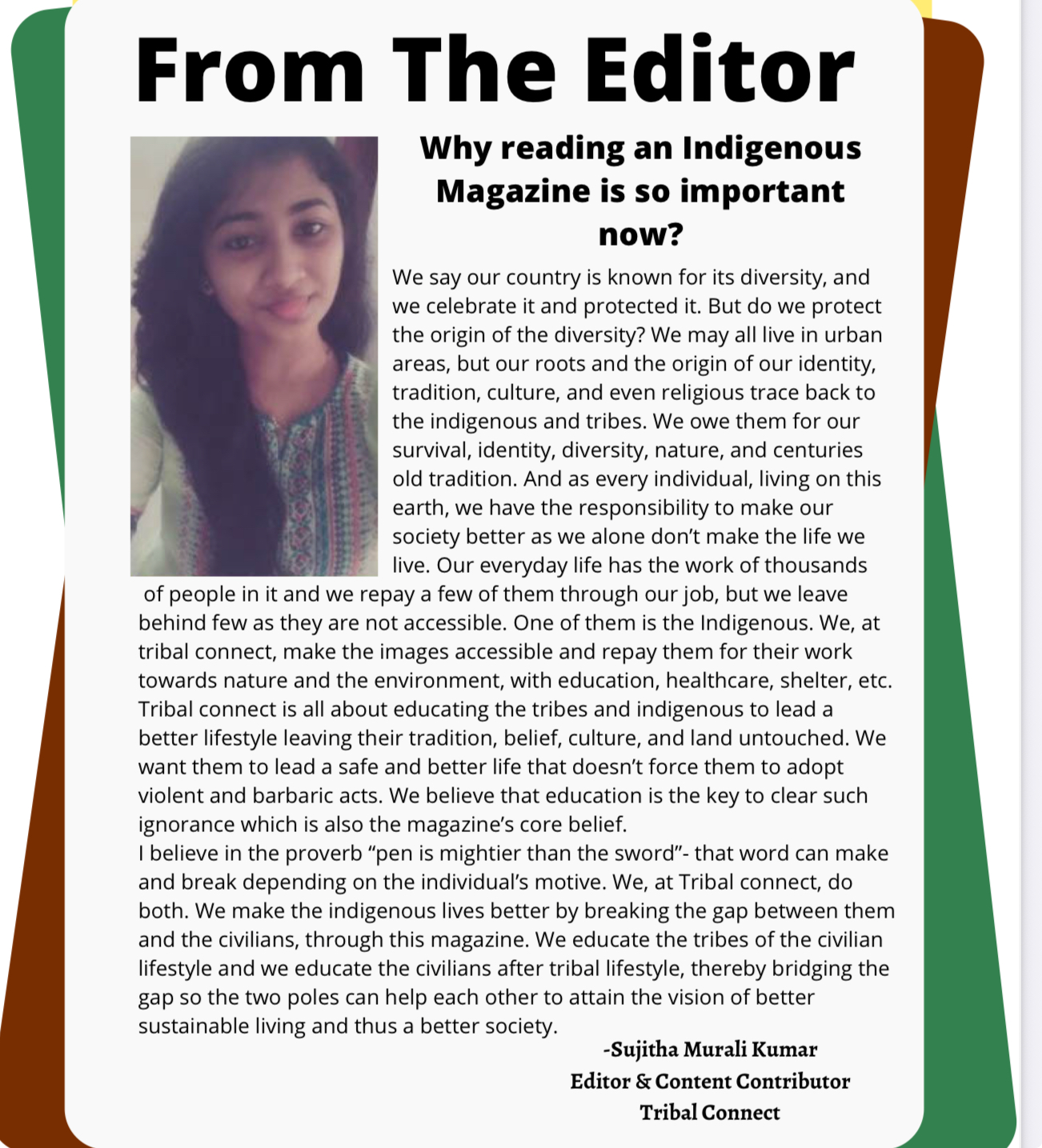
“uplift and benefit the community without adversely affecting or changing their vernacular”:
TribalConnect Volume 04 | April 2022 l Official website >>
TRIBAL NOISE | 09 Excerpt: Isak Munda
From off beaten tracts to be unbeaten
– Grace Nivedita SithaRaman (Wunn)
This is the day when i shall hold you in wonder!
When I disclose to you a tribal labourer.
In the green corner of the tribal hamlet of hilly Sambalpur, In the state of Jaganatho – Odisha, lives a hard working daily wage labourer
Isak Munda, the tribal man from Babupali village under Jujumura.
Have you heard about him?
Isak led a life of an impoverished land worker.
Has adhaar, voter id but not a baker.
Earning not enough for his three daughters, wife, his Ma and Baba.
Not even a shoe string, to bind the seven in a hope giving rainbow.
Tribal lives are simple, self sufficient, they are born in the lap of nature, the hilly tracts, the forest trail, their vegetable basket and their pharmacy.
Beaten by the wind and rain, bitten by rodents, vipers life threatening lizards,
Kissed by the Zephyr and komorabi,
Their backs tortured by the sweltering heat,
The tribals write their sweetest stories on their chest, beads, tattoos.
On the mud baked walls of their homes,
The jungle courtyard,
the green, moist, slippery and dead dry tracks, they believe here the goddesses roam.
Every element of Nature, Nature’s love in every element,
The Tribes worship with reverence.
So, what upscaled the life of tribal man Isak Munda?
[…]
“Solar energy is a rediscovery of an ancient truth—that the Sun is the most democratic source of energy, accessible to all and belonging to none. The ‘Solar for All’ initiative of the Government of India is based on this concept. Solar energy should not remain confined to the rooftops of the privileged. It should illuminate the homes of the poorest and open new opportunities for every person seeking a livelihood. Solarisation at large scale will democratise energy use, enabling citizens to become active participants in building a cleaner and more equitable planet.” – Droupadi Murmu (speech held on 28 October 2025) | Backup | Speeches by the President of India >>
Up-to-date reports by Indian experts and journalists
List of sites covered by this Google SafeSearch engine
Academia.edu (platform for academics to share research papers) – www.academia.edu
Archive.org – https://archive.org
Centre for Science and Environment – https://www.cseindia.org
Current Conservation – https://www.currentconservation.org
Development and Cooperation (D+C) https://www.dandc.eu
Down To Earth (India) – www.downtoearth.org.in
India Environment Portal – www.indiaenvironmentportal.org.in
Harnessing Nature Magazine – https://harnessingnature.online
Kalpavriksh Environmental Action Group – https://kalpavriksh.org
Mongabay-India – https://india.mongabay.com
M S Swaminathan Research Foundation – www.mssrf.org
Navdanya (protecting India’s biodiversity based food heritage) – https://navdanya.org
People’s Archive of Rural India – https://ruralindiaonline.org/
Third World Network (Penang, Malaysia) – https://twn.my
The Shola Trust (nature conservation in the Nilgiri region) – www.thesholatrust.org
TribalConnect (“uplift and benefit the community without adversely affecting or changing their vernacular”) – https://tribalconnect.org.in
WorldCat (“the world’s largest library catalog, helping you find library materials online”) – https://worldcat.org
More SafeSearch on this website
Search tips
Combine the name of any particular state, language or region with that of any tribal (Adivasi) community.
Add keywords of special interest (music, poetry, dance just as health, sacred grove and biodiversity); learn about the rights of Scheduled Tribes such as the “Forest Rights Act” (FRA); and the United Nations “Declaration on the Rights of Indigenous Peoples”, “Universal Declaration of Human Rights”, “women’s rights”, or “children’s right to education”.
Ask a question that includes “tribal” or “Adivasi”, for instance: “Adivasi way of life better?” (or “tribal way of life worse?”)
Specify any particular issue or news item (biodiversity, bonded labour and human trafficking, climate change, ecology, economic development, ethnobotany, ethnomedicine, global warming, hunter-gatherers in a particular region or state, prevention of rural poverty, water access).
For official figures include “scheduled tribe ST” along with a union state or region: e.g. “Chhattisgarh ST community”, “Himalayan tribe”, “Scheduled tribe Tamil Nadu census”, “ST Kerala census”, “Particularly Vulnerable Tribal Group Jharkhand”, “PVTG Rajasthan”, “Adivasi ST Kerala”, “Adibasi ST West Bengal” etc.
SafeSearch browser tips
If your (mobile) browser fails to display “embedded” media contents, Google maps and SafeSearch windows
Try another browser like Firefox, Chrome or Safari available on your device
Ensure your favourite browser is up to date
Close your present browser
Check your browser and mobile (gsm) settings:
e.g. permission for video or JavaScript
(seen under Preferences >Security >Enable JavaSript)
Restart your computer (smartphone, tablet)
Reconnect to your wifi network or connect to a different one
On some iPhone models the following helps:
>Settings >Safari >scroll down to:
SETTING FOR WEBSITES
Enable “Request Desktop Website” (All Websites) temporarily
Return to the map-post in Safari and “Reload”
Return to >Settings and disable “Request Desktop Website” again
Return to the post in Safari and “Reload”which should now display “embedded” contents as intended (with the convenience of browsing the mobile version on a small screen)
Note: similar solutions may also work with other mobile operating systems.
What does it mean to be Indigenous?
Indigenous Peoples can be identified according to certain characteristics:
They are politically and socially marginalized.
Most importantly, they self-identify as Indigenous Peoples.
They share an ancestral link with those who inhabited a country or region before they were colonized or before other peoples became dominant.
They have a strong link to particular territories and the surrounding natural resources.
They have distinct social, economic or political systems, which they are resolved to maintain and reproduce.
They have a distinct language, culture and beliefs.
There are more than 5,000 different Indigenous Peoples around the world comprising 476 million people – around 6.2% of the global population. They are spread across more than 90 countries in every region and speak more than 4,000 languages. | Learn more (Amnesty International) >>
Source: “INDIGENOUS PEOPLES’ RIGHTS” by Amnesty International
URL: https://www.amnesty.org/en/what-we-do/indigenous-peoples/
Date Visited: 10 May 2025
Learn more on the Rights of Indigenous Peoples, their Languages & linguistic heritage & Tribal culture worldwide >>