I am glad to be participating in the Human Rights Day celebration organised by the National Human Rights Commission. It is an important occasion for the whole of humankind, as it was on this day in 1948 that the United Nations General Assembly adopted the Universal Declaration of Human Rights, also known as UDHR. […]
Climate change is knocking on the doors. People in the poorer nations are going to pay a heavier price for the degradation of our environment. We must consider the environmental dimension of justice now.
The challenge of climate change is so enormous that it forces us to redefine ‘rights’.
Five years ago, as you know, the High Court of Uttarakhand held that the Ganga and Yamuna rivers have the same legal rights as human beings. But why stop at only two rivers? India is a land of sacred geography, with countless holy lakes, rivers and mountains. To these landscapes, the flora and fauna add rich biodiversity. In old times, our sages and seers saw them all as part of a universal whole, along with us. So, just as the concept of human rights exhorts us to consider every human being as no different from us, we should treat the whole living world and its habitat with respect.
I wonder what would the animals and trees around us tell us if they could speak. What would our rivers say about human history and what would our cattle say on the topic of human rights. We have trampled on their rights for long, and now the results are before us. We must learn – rather re-learn – to treat nature with dignity. This is not only a moral duty; let us remember it is necessary for our own survival too.
Source: “ADDRESS BY THE PRESIDENT OF INDIA, SMT DROUPADI MURMU ON THE OCCASION OF HUMAN RIGHTS DAY CELEBRATION ORGANISED BY THE NATIONAL HUMAN RIGHTS COMMISSION” (New Delhi : 10.12.2022)
URL: https://www.presidentofindia.gov.in/speeches-detail.htm?993
Date Visited: 14 December 2022
[Bold typeface added above for emphasis]
“Solar energy is a rediscovery of an ancient truth—that the Sun is the most democratic source of energy, accessible to all and belonging to none. The ‘Solar for All’ initiative of the Government of India is based on this concept. Solar energy should not remain confined to the rooftops of the privileged. It should illuminate the homes of the poorest and open new opportunities for every person seeking a livelihood. Solarisation at large scale will democratise energy use, enabling citizens to become active participants in building a cleaner and more equitable planet.” – Droupadi Murmu (speech held on 28 October 2025) | Backup | Speeches by the President of India >>
UN’s Declaration of Human Rights is over 75 years old — time for a refresh
CBC IDEAS examines the UN’s Declaration of Human Rights and looks to the future in a five-part series
Rights for the Future
Listen to the podcast: What rights do we need for our future?
If the Universal Declaration of Human Rights were rewritten today, what rights would we add to strive for a more just world?
In the final panel, Nahlah Ayed and guests look beyond our fractured present and try to imagine what new rights we need for our own millennium.
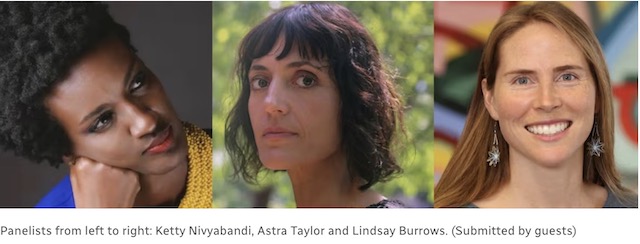
Guests in this episode:
Astra Taylor is a filmmaker and writer, and the 2023 CBC Massey lecturer. She is also the co-founder of The Debt Collective. Among other books she is the author of The Age of Insecurity, Democracy May Not Exist But We’ll Miss It When It’s Gone, and most recently, co-author of Solidarity.
Lindsay Borrows is a lawyer, author, and professor at Queen’s University Faculty of Law. Her work supports Indigenous communities to revitalize and apply their own legal traditions to promote environmental stewardship. She is a member of the Chippewas of Nawash First Nation.
Ketty Nivyaband is a global human rights activist and advocate, she holds in-depth and lived expertise on asylum and displacement, human rights in political transitions, freedom of expression and civic space and the intersections of gender, race, democracy, and human rights. Her work as Secretary General for Amnesty International Canada’s English-Speaking section is rooted in peoplepower, public accountability, and a feminist, decolonial approach to human rights.
Source: CBC Radio-Canada
URL: https://www.cbc.ca/radio/ideas/the-universal-declaration-of-human-rights-brave-new-worlds-series-1.7307081
Date Visited: 15 July 2025
“The Hindu Kush-Himalayan region holds the third largest body of frozen water in the world, and is warming at double the global average. It stands to lose one third of its glaciers by 2100 – creating huge risk to mountain communities, ecosystems and nature and the quarter of humanity downstream.” – Deepshikha Sharma (climate and environment specialist at the International Centre for Integrated Mountain Development, ICIMOD) quoted by BBC Podcast “The Climate Question” | Learn more | Biodiversity and development – Himalaya >>
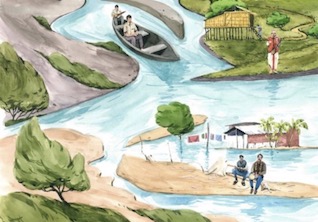
As the mighty river flows, so does the natural music of the pain of environmental change. […] Songs have always chronicled social, political, historic, geographical, cultural and environmental change. Many popular singers have responded to the climate crisis. | The Changing Climate In The Songs Of The Brahmaputra (The Wire) | United Nations on climate change >> >>
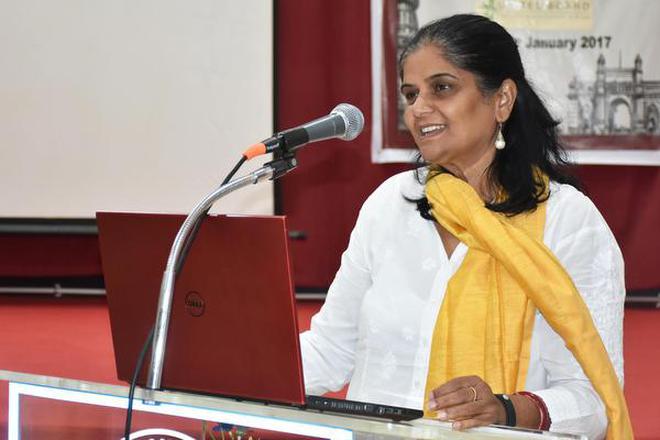
Learn more from Mari Thekaekara >>
Are the ‘goods’ and ‘bads’ of physical events such as global warming equally distributed? Are there proper climate governance mechanisms sensitive to differentiated responsibility and risks, mitigated justly for suffering marginalised communities? | Read “Climate Justice: India Is Disproportionately Endangered – as Are Some Indians” on Mongabay | Learn more about climate change | United Nations on climate change >>