by Sanchari Pal on The Better India >>
UNESCO World Heritage Centre >>
Rabindranath Tagore’s speech on the swadeshi idea of the “National University”
Excerpt from Tanika Sarkar’s book review:
As Bhattacharya reminds us, Tagore opposed colonial pedagogy not because it originated in a foreign context, but because it lacked organic connections with the material lifeworld and socio-cultural experiences of the Indian ‘public’ that it sought to educate. Bhattacharya clarifies and extends the concept of ‘publicness’ of education which should be sustained by, and also sustain, the immediate local environment: a cooperative model, co-partnered by the public and the university.
May I underline yet another remarkable imperative which put Tagore at odds with most nationalists of his time? Tagore was an internationalist, in an intellectual, cultural and political sense: keen to be grounded in, and to ground his university in, global cultures and ideas, as well as in Indian ones. The Gandhi-Tagore debates are significant in this context and in this sense Tagore had much in common with Nehru. This is important to recall today when the entire national educational agenda is geared towards keeping the world out of Indian thinking, to confine the universities to navel gazing and self-congratulation.
Source: “Tracing the History of India’s Universities” (book review for Debaditya Bhattacharya’s The Indian University: A Critical History) by Tanika Sarkar
URL: https://www.orientblackswan.com/pdfs/media/9789354426360_Book_review_080925.pdf
Date Visited: 29 January 2026
“If Tagore had done nothing else, what he did at Santiniketan and Sriniketan would be sufficient to rank him as one of India’s greatest nation-builders.” – Krishna Kripalani in Rabindranath Tagore: A Biography | UNESCO World Heritage Centre >>
“Society as such has no ulterior purpose. It is an end in itself. It is a spontaneous self- expression of man as a social being. It is natural regulation of human relationships, so that men can develop ideals of life in cooperation with one another.” – Rabindranath Tagore quoted in Santiniketan: Birth of Another Cultural Space by Pulak Dutta (Santiniketan, 2015) p. 42 [from The English Writings of Rabindranath Tagore, Vol. II, Sahitya Akademi, New Delhi, 2004, p. 421] | UNESCO World Heritage Centre >>
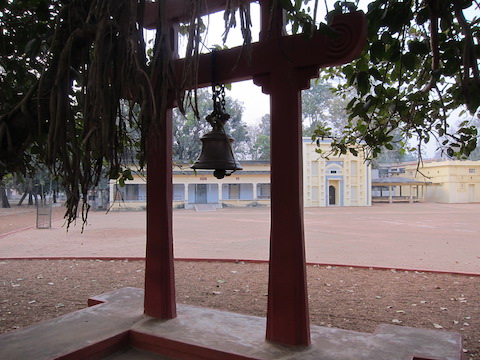
Santiniketan’s bell – Photo © Ludwig Pesch
Located about 158 km northwest of Kolkata in Bengal’s rural hinterland, Santiniketan embodies Rabindranath Tagore’s vision of a place of learning that is unfettered by religious and regional barriers. Established in 1863 with the aim of helping education go beyond the confines of the classroom, Santiniketan grew into the Visva Bharati University in 1921, attracting some of the most creative minds in the country. | To read the full story and view more photos in high resolution, click here >>
As one of the earliest educators to think in terms of the global village, he envisioned an education that was deeply rooted in one’s immediate surroundings but connected to the cultures of the wider world.
With this in mind, on December 22, 1901, Rabindranath Tagore established an experimental school at Santiniketan with five students (including his eldest son) and an equal number of teachers. He originally named it Brahmacharya Ashram, in the tradition of ancient forest hermitages called tapoban.
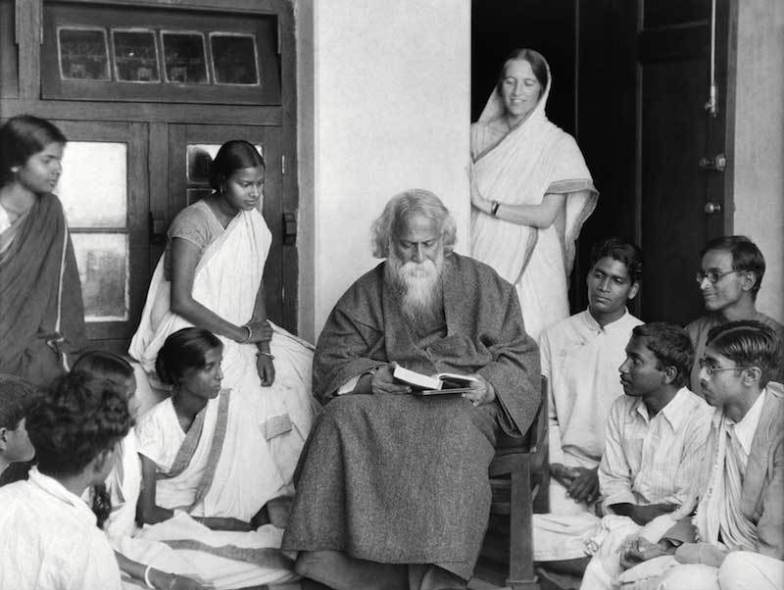
Rabindranath Tagore and Students, Santiniketan, 1929.The guiding principle of this little school is best described in Tagore’s own words, “The highest education is that which does not merely give us information but makes our life in harmony with all existence.” […]
Tagore wanted his students to feel free despite being in the formal learning environment of a school, because he himself had dropped out of school when he found himself unable to think and felt claustrophobic within the four walls of a classroom. […]
Flexible class schedules allowed for shifts in the weather and the seasonal festivals Tagore created for the children.
In an attempt to help with rural reconstruction, Tagore also sought to expand the school’s relationship with the neighbouring villages of the Santhal tribal community. Thanks to his efforts, Santiniketan has today become the largest centre for educated Santhals in West-Bengal. Many of them have become teachers, several serving in Visva Bharati itself, while others have become social workers.
Santiniketan can be credited with taking the first path breaking steps in the field of education at a time when the country was slowly getting hitched to the European mode of education (textual and exam oriented knowledge imparted in closed classrooms).
Other than a humane and environment friendly educational system that aimed at overall development of the personality, Santiniketan also offered one of the earliest co-educational programmes in South Asia. […]
Tagore was one of the first to support and bring together different forms of arts at Santiniketan. He invited artists and scholars from other parts of India and all over the world to live together at Santiniketan on a daily basis and share their cultures with the students of Visva Bharati. He once wrote:
“Without music and the fine arts, a nation lacks its highest means of national self-expression and the people remain inarticulate.” […]The grand Poush Utsav is celebrated on the Foundation Day of the University, while the colourful Basant Utsav is celebrated on the occasion of Holi. The Nandan Mela, which was originally started to raise money for a poor student who needed money for treatment, is today an event where university students display and sell their art. Other events like the Sarodotsav (Autumn Festival), Maghotsav (Founding Day of the Sriniketan campus) and Brikhsharopan Utsav (Tree Planting Festival) are also celebrated with great pomp and fervour.
On all these occasions, the entire campus has a festive atmosphere, with baul (traditional wandering minstrels of Bengal) songs, tribal dances, and other cultural performances being organised throughout the township. […]Thanks to Tagore’s legacy, Santiniketan has managed to preserve Bengal’s fast-disappearing rural crafts culturethrough folk markets, like the weekly Bondangaar Haat, and rural co-operatives, like Amar Kutir. […]
This ground-breaking outlook is also the reason why Santiniketan has given India many luminaries like pioneering painter Nandalal Bose, famous sculptor Ramkinkar Baij, Nobel-winning economist Amartya Sen, globally renowned filmmaker Satyajit Ray, and the country’s leading art historian R. Siva Kumar. The University also has several eminent international alumni that include Indonesian painter Affandi, Italian Asianist Giuseppe Tucci, Chinese historian Tan Chung, eminent Indologist Moriz Winternitz, and Sri Lankan artist Harold Peiris, among many others. Pouring his creative genius into his work, Tagore himself produced some of his best literary works, paintings and sketches at Santiniketan. Over the years, Santiniketan has adapted to the changing times. But the essence of the place is still what Tagore wanted it to be.
The Nobel Laureate’s life, philosophy and literary works find their greatest reflection in Santiniketan, where classes are still taught in the open, where nature and its seasons are still celebrated instead of religious festivals, where the graduation ceremony is marked by the gifting of a chhatim leaf, and where education is rooted in Tagore’s philosophy that “the whole world can find a nest.” […]
How to reach Santiniketan
The distance from Kolkata to Santiniketan is about 182 km. Santiniketan is well connected to Kolkata via road and rail.
By Rail: The nearest station is Bolpur. Take the Visva-Bharati Fast Passenger or Rampurhat Express from Howrah to reach Bolpur within 2.5 hours.
By Road: If you follow the Durgapur Expressway, it takes approximately 4 hours to reach Santiniketan. Buses to Bolpur are available from Esplanade bus terminal in Kolkata […]
Source: Exploring Tagore’s Santiniketan, a Unique Abode of Learning” by Sanchari Pal, The Better India, 31 August 2016
Address: https://www.thebetterindia.com/66627/santiniketan-rabindranath-tagore-bengal/
Date Visited: 21 April 2023
Rabindranath Tagore, philosopher, educator, novelist, poet and painter, is without challenge one of the greatest and most noble figures of modern times. Not only was he awarded the rare honour of the Nobel Prize for Literature, but he also won the distinction far more rare, less spectacular but much more significant, of having his works translated into different languages by writers of equal glory, Nobel Prize winners in their own right, such as André Gide in French and Juan Ramon Jimenez in Spanish. […]
India today does not celebrate merely the thinker and writer. Above all, India reveres Tagore’s generous, universal soul, open to the problems not only of his own land but of the world, the son of the Maharshi Debendranath Tagore, who had been one of the guiding spirits of the Brahma-Samaj. For one of his greatest works, the monumental novel Gora, Rabindranath was to choose as theme the trials and problems of this movement. It is not merely by chance that Unesco, among its many undertakings towards the celebration of Tagore’s Centenary, has decided to publish the first French translation of this very novel. For in this book the poet stresses with great fervour and by moving scenes depicted with all his skill as a writer, his zealous devotion to the ideal of a casteless world, a world without cruel, irrational discrimination between one human being and his fellow men. […]
Writing days after Tagore’s death in August 1941, Jawaharlal Nehru said : “Both Gurudev and Gandhiji took much from the West and from other countries, especially Gurudev. Neither was narrowly national. Their message was for the world.” Tagore was in truth a living link between East and West. And so he willed it. His entire life he fought against narrow distrust of foreign cultures. He had faith in the fruitfulness of cultural intercourse and friendship. With this message he was and remains a Guru to Unesco, and it is both fitting and imperative that Unesco’s homage to Tagore should join that of the rest of mankind.
Vittorino Veronese
Source: “Rabindranath Tagore: a universal voice”: Message from the Director-General of Unesco, to the Tagore Centenary celebrations in Bombay in January [1961] | Read this article (PDF 50KB) >>
URL: https://en.unesco.org/courier/decembre-1961
Date accessed: 3 September 2021
The life and work of Amartya Sen embodies the ethos of Santiniketan
If ever the idea of an institution could be captured and carried forward by a single individual, the life and work of Amartya Sen have truly embodied the ethos of Santiniketan, the university town with Visva-Bharati University at its centre. Sen, true to Tagore’s vision of Santiniketan, is an intellectual at home in the world. His ideas, drawn from his Indian experiences, have enriched global economic thought and moral philosophy tremendously. But Visva-Bharati today is a changed institution — instead of celebrating Sen as one of its exemplars, it has initiated eviction proceedings against him. [I]n today’s Visva-Bharati, it would be no surprise if Tagore isn’t read at all.
Source: “Fall from grace” by Arghya Sengupta, The Telegraph, 20 April 2023
URL: https://www.telegraphindia.com/opinion/fall-from-grace-visva-bharatis-hounding-of-amartya-sen/
Date Visited: 21 April 2023