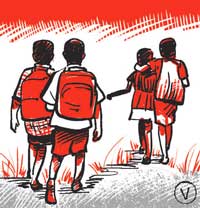
“She spoke about the ordeals of adolescent girls in rural India and the solutions needed”: Workshops for marginalized girls – Uttarakhand, Andhra Pradesh & Telangana
Read the full article with view photos, click here >>
A 15 days long camp has enabled shy and timid girls to come out in the open, be confident and look at the world with a new perspective. From providing life skills, decision making power and spoken English training to enabling them to dream big and become more confident, VOICE 4 Girls is giving a new voice to thousands of adolescent girls. […]
VOICE 4 Girls is one such platform that enables young adolescent girls to get access to critical knowledge, life skills and spoken English to help them become the decision makers of their lives.
“We believe that these adolescent girls can be the agents of change. If we educate one girl, it changes a whole family and community,” says Anusha Bharadwaj, executive director, VOICE 4 Girls.
What started as a small initiative by three IDEX fellows in 2011 is now a movement which has positively impacted the lives of thousands of other girls like Mansa. With an interesting model that works with government and low-cost private schools, the NGO has managed to reach out to over 11,500 underserved kids so far. […]
The camps are organized twice a year; once in summer and once in winter. They take place in Uttarakhand, Andhra Pradesh and Telangana. The average camp lasts for two to four weeks. Every camp has volunteers working as counselors and field coordinators who are paid a stipend for their services. College students and teachers are selected as the counselors and coordinators who get an opportunity to work closely with the students and to become their role models. […]
Her Voice
This camp focuses on girls aged between 11 to 16 years. This camp helps the girls to come out of their shells and look at their life in a different light. Various community-based activities expose the girls to new people and places, and expose them to life skills such as problem-solving, negotiation and decision-making along with the basics of communication in English.
By the end of the camp, the girls are much more confident, active and independent. They are eager to learn new things and are open to raising questions about various social norms. […]
The organization plans to conduct more camps for both girls and boys to make it more inclusive. They are also planning to extend their reach to other states as well in the next couple of years.
In addition to this, they plan to reach out to day-schools too in the near future. “We currently focus mainly on residential schools. Reaching out to the regular day-schools is next on our agenda, apart from empowering as many kids as possible,” Gautam says. They also plan to organize regular camps all year round instead of doing it just twice a year.
States Parties shall respect the responsibilities, rights and duties of parents or, where applicable, the members of the extended family or community as provided for by local custom, legal guardians or other persons legally responsible for the child, to provide, in a manner consistent with the evolving capacities of the child, appropriate direction and guidance in the exercise by the child of the rights recognized in the present Convention. […]
Adopted and opened for signature, ratification and accession by General Assembly resolution 44/25 of 20 November 1989 entry into force 2 September 1990, in accordance with article 49
Objective of EMRS (“Eklavya Model Residential Schools”) [Peruse the government guidelines here or in the 2010 backup included below]
i. Comprehensive physical, mental and socially relevant development of all students enrolled in each and every EMRS. Students will be empowered to be change agent, beginning in their school, in their homes, in their village and finally in a large context.
ii. Focus differentially on the educational support to be made available to those in Standards XI to X, so that their distinctive needs can be met.
iii. Support the annual running expenses in a manner that offers reasonable remuneration to the staff and upkeep of the facilities.
iv. Support the construction of infrastructure that provides education, physical, environmental and cultural needs of student life. […]
“The Big-brother attitude of educators must end. The approach to tribal education has to be a two-way transaction of give and take, based on an informed appreciation of traditional tribal values and wisdom.” – Uma Ram (Professor & Head Department of English, Kakatiya PG College, Chhattisgarh) in Issues in Tribal Education in Bastar, Chhattisgarh (Folklore Foundation, Lokaratna, Volume IV 2011)
Ekalavya (Eklavya, Eklabya): the name of a legendary archer prodigy “who, being a Nishada [Sanskrit Niṣāda, “tribal, hunter, mountaineer, degraded person, outcast”], had to give his thumb as a fee to the brahmin guru thus terminating his skill as an archer.” – Romila Thapar (“The epic of the Bharatas”) | Read the full paper here | Backup download link (pdf) >>
More about India’s “Ekalavya Residential School Scheme”, “Ashram Schools” and “Factory schools”
Ekalavya Residential School Scheme (EMR): a network of boarding schools where tribal children are to be educated in accordance with rules and syllabi provided by the government; such schools are being designated as “Eklavya Model Residential School (EMR)” with the objective of empowering students “to be change agent, beginning in their school, in their homes, in their village and finally in a large context.” – Government Guidelines 2010 | Backup >>
Residential School and Ashram School In some regions there are similar “Residential Schools” and “Ashram Schools” for tribal children, as in Tripura where they are managed by a society called “Tripura Tribal Welfare Residential Educational Institutions Society (TTWREIS)” – Tribal Welfare Department, Government of Tripura
Factory schools “exist to turn tribal and indigenous children – who have their own language and culture – into compliant workers-of-the-future. The world’s largest Factory School stated that it turns ‘Tax consumers into tax payers, liabilities into assets’.” – survivalinternational.org/factoryschools | Learn more >>
WorldCat (“the world’s largest library catalog, helping you find library materials online”) – https://worldcat.org
Search tips
Combine the name of any particular state, language or region with that of any tribal (Adivasi) community.
Add keywords of special interest (music, poetry, dance just as health, sacred grove and biodiversity); learn about the rights of Scheduled Tribes such as the “Forest Rights Act” (FRA); and the United Nations “Declaration on the Rights of Indigenous Peoples”, “Universal Declaration of Human Rights”, “women’s rights”, or “children’s right to education”.
Ask a question that includes “tribal” or “Adivasi”, for instance: “Adivasi way of life better?” (or “tribal way of life worse?”)
Specify any particular issue or news item (biodiversity, bonded labour and human trafficking, climate change, ecology, economic development, ethnobotany, ethnomedicine, global warming, hunter-gatherers in a particular region or state, prevention of rural poverty, water access).
For official figures include “scheduled tribe ST” along with a union state or region: e.g. “Chhattisgarh ST community”, “Himalayan tribe”, “Scheduled tribe Tamil Nadu census”, “ST Kerala census”, “Particularly Vulnerable Tribal Group Jharkhand”, “PVTG Rajasthan”, “Adivasi ST Kerala”, “Adibasi ST West Bengal” etc.
SafeSearch browser tips
If your (mobile) browser fails to display “embedded” media contents, Google maps and SafeSearch windows
Try another browser like Firefox, Chrome or Safari available on your device
Ensure your favourite browser is up to date
Close your present browser
Check your browser and mobile (gsm) settings: e.g. permission for video or JavaScript (seen under Preferences >Security >Enable JavaSript)
Restart your computer (smartphone, tablet)
Reconnect to your wifi network or connect to a different one
On some iPhone models the following helps:
>Settings >Safari >scroll down to: SETTING FOR WEBSITES
Return to >Settings and disable “Request Desktop Website” again
Return to the post in Safari and “Reload”which should now display “embedded” contents as intended (with the convenience of browsing the mobile version on a small screen)
Note: similar solutions may also work with other mobile operating systems.