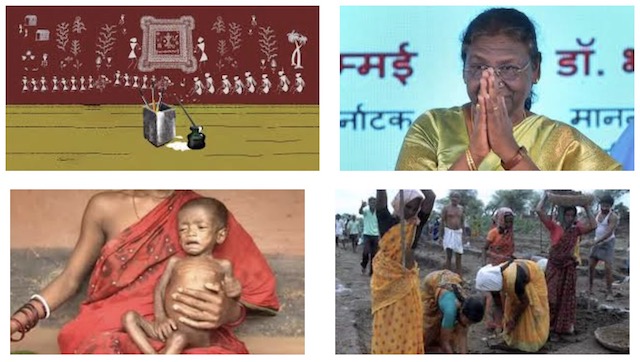
“Together, we must endeavour to strengthen tribal communities which are the role model in preservation of water, forest and land, and learn from their connection with nature and the surrounding environment for the sake of the entire human race.” – journalist and tribal rights activist Dayamani Barla in The Wire >>
The Tribunal also issued notices to the state governments of Maharashtra, Karnataka, Goa, Kerala, Gujarat and Tamil Nadu seeking their replies on the plea for implementation of the report by Western Ghats Ecology Expert Panel (WGEEP) on the protection and preservation of Western Ghats.
The plea by two NGOs, Goa Foundation and Peaceful Society, told the Tribunal that the MoEF had set up the WGEEP in March 2010, given the environmental sensitivity and ecological significance of the region.
The WGEEP in its report to MoEF dated August 31, 2011 has designated the entire Western Ghats as an Ecologically Sensitive Area and categorised the whole region in three classes according to their ecological sensitivities.
The NGOs sought to restrain the authorities from granting fresh nods to projects in regions in the first two categories which include 97 talukas in 44 districts of six states.
The WGEEP had in its report recommended that no mining should be allowed in the Western Ghats in Goa. […]
The NGOs have sought an interim order seeking directions that no fresh clearances be granted to projects in the two categories. […]
Terming the Western Ghats as “hotspots of biodiversity”, the petition stated that the region harbours the largest global populations of the Asian Elephant and besides other mammals such as tiger.
“By and large the Western Ghats have been subjected to a rapid erosion of natural capital with the building up of man-made capital, regrettably imposing excessive, unnecessary environmental damage in the process, accompanied by a degradation of social capital as well,” the petition said.
Source: “Green Tribunal seeks MoEF’s response on plea on Western Ghats”, The Hindu, New Delhi, May 31, 2012 Address : http://www.thehindu.com/sci-tech/energy-and-environment/article3476285.ece?homepage=true Date Visited: Sun Jun 03 2012 11:22:32 GMT+0200 (CEST)
Up-to-date reports by Indian experts and journalists
List of sites covered by this Google SafeSearch engine
Academia.edu (platform for academics to share research papers) – www.academia.edu
Combine the name of any particular state, language or region with that of any tribal (Adivasi) community.
Add keywords of special interest (music, poetry, dance just as health, sacred grove and biodiversity); learn about the rights of Scheduled Tribes such as the “Forest Rights Act” (FRA); and the United Nations “Declaration on the Rights of Indigenous Peoples”, “Universal Declaration of Human Rights”, “women’s rights”, or “children’s right to education”.
Ask a question that includes “tribal” or “Adivasi”, for instance: “Adivasi way of life better?” (or “tribal way of life worse?”)
Specify any particular issue or news item (biodiversity, bonded labour and human trafficking, climate change, ecology, economic development, ethnobotany, ethnomedicine, global warming, hunter-gatherers in a particular region or state, prevention of rural poverty, water access).
For official figures include “scheduled tribe ST” along with a union state or region: e.g. “Chhattisgarh ST community”, “Himalayan tribe”, “Scheduled tribe Tamil Nadu census”, “ST Kerala census”, “Particularly Vulnerable Tribal Group Jharkhand”, “PVTG Rajasthan”, “Adivasi ST Kerala”, “Adibasi ST West Bengal” etc.
SafeSearch browser tips
If your (mobile) browser fails to display “embedded” media contents, Google maps and SafeSearch windows
Try another browser like Firefox, Chrome or Safari available on your device
Ensure your favourite browser is up to date
Close your present browser
Check your browser and mobile (gsm) settings: e.g. permission for video or JavaScript (seen under Preferences >Security >Enable JavaSript)
Restart your computer (smartphone, tablet)
Reconnect to your wifi network or connect to a different one
On some iPhone models the following helps:
>Settings >Safari >scroll down to: SETTING FOR WEBSITES
Return to >Settings and disable “Request Desktop Website” again
Return to the post in Safari and “Reload”which should now display “embedded” contents as intended (with the convenience of browsing the mobile version on a small screen)
Note: similar solutions may also work with other mobile operating systems.
What does it mean to be Indigenous?
Indigenous Peoples can be identified according to certain characteristics:
They are politically and socially marginalized.
Most importantly, they self-identify as Indigenous Peoples.
They share an ancestral link with those who inhabited a country or region before they were colonized or before other peoples became dominant.
They have a strong link to particular territories and the surrounding natural resources.
They have distinct social, economic or political systems, which they are resolved to maintain and reproduce.
They have a distinct language, culture and beliefs.
There are more than 5,000 different Indigenous Peoples around the world comprising 476 million people – around 6.2% of the global population. They are spread across more than 90 countries in every region and speak more than 4,000 languages. | Learn more (Amnesty International) >>