Sushanta Talukdar, Guwahati, June 19, 2011
Cooked Miaotong rice remains fresh for at least three days
Two traditional rice varieties produced by the Singphos — Miaotong and Khawlung, used in making topola bhaat, a delicacy of the tribe and popular with tourists — are set to earn the status of being the first registered farmers’ variety from Assam under the Protection of Plant Varieties and Farmers’ Rights Authority regime. […]
“Once registered, the Singpho community will enjoy an exclusive right for commercial production of these varieties and also a share of the benefit, if anyone outside the community, with its consent, cultivates tem on a commercial scale,” said Dr. Talukdar.
The specialty of Miaotong is that cooked rice remains fresh for at least three days. Miaotong-soaked water is also used as shampoo, according to community elders. […]
Source: The Hindu : News / National : Assam tribe’s rice varieties win recognition
Address : http://www.thehindu.com/news/national/article2116215.ece
Date Visited: Mon Apr 02 2012 10:22:31 GMT+0200 (CEST)
Learn more about health and nutrition
The Food Book of four communities in the Nilgiri mountains: Gudalur Valley – Tamil Nadu
Recommendations by the Expert Committee on Tribal Health – Government of India
Wild food festivals & Slow Food Youth Network (SFYN): The world’s most important food movement
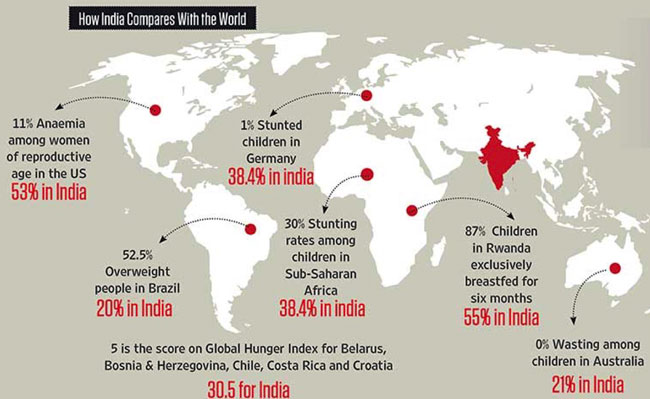
Graphic © Outlook India 26 August 2019 >>
The tribal food basket has always been diverse and nutritious >>
Childrens rights: UNICEF India | Childrens right to education >>
Health spending by the Indian government
“Health spending by the Indian government as percentage of GDP has long been one of the lowest for any major country, and the public health system is chronically dismal.” – Pranab Bardhan in “The two largest democracies in the world are the sickest now” | Learn more: Scroll.in, 24 August 2020 >>
Context | Health care for communities identified as “poorest of poor” (PVTGs)
India is designated as the melting pot of so many ethnic groups dwelling at the same time under the common umbrella of a unified nation. Among these varied ethnic groups, some of them have been categorized under article 342 (1) of the constitution and have been labelled as Scheduled Tribe. In the post independent scenario, several schemes for upliftment of STs were run by the government but it was found that all these groups did not come up to the same level of development. Some of them were at much lower strata than others. Thus, in order to ensure the development of these communities, they were, for the first time in 1975-76 (during 5th Five-year plan) and thereafter-in 1993, identified as poorest of poor among the STs and were designated as Primitive Tribal Groups and thereafter constitution of India renamed and declared as Particularly Vulnerable Tribal Groups (PVTGs). Out of the 75 particularly vulnerable tribal groups, 13 are residing in Odisha; they are becoming increasing vulnerable due to loss of their customary habitat. The health troubles of rural areas especially in the tribal areas need a unique concentration, because the tribal people have typical health problem.
Source: 2019 PhD thesis (Abstract) by Jayanta Kumar Nayak titled “Health Seeking Behaviour and Health Care Services among the Hill Kharia Mayurbhanj District Odisha”, Department of Anthropology, Central University of Orissa
URL: http://hdl.handle.net/10603/257651
Date Visited: 21 May 2025
Factchecker.in | Safe search examples with keywords:
“tribal rights unesco“ | “rural india unesco“ | “tribal education india unesco“
Tips for using interactive maps
Toggle to normal view (from reader view) should the interactive map not be displayed by your tablet, smartphone or pc browser
For details and hyperlinks click on the rectangular button (left on the map’s header)
Scroll and click on one of the markers for information of special interest
Explore India’s tribal cultural heritage with the help of another interactive map >>