“Southern Zonal Council, comprising the States of Andhra Pradesh, Karnataka, Kerala, Tamil Nadu, Telangana and the Union Territory of Puducherry” – Government of India in “Zonal Councils – Genesis” (accessed 3 April 2021)
http://interstatecouncil.nic.in/genesis/
https://indiantribalheritage.org/?page_id=20801
Zonal Cultural Centres
https://indiantribalheritage.org/?p=13904
Shodhganga: a reservoir of Indian theses – https://shodhganga.inflibnet.ac.in About Shodhganga A reservoir of Indian ThesesThe Shodhganga@INFLIBNET Centre provides a platform for research students to deposit their Ph.D. theses and make it available to the entire scholarly community in open access. The repository has the ability to capture, index, store, disseminate and preserve ETDs submitted by the researchers. … Read more
The adivasi women of Edamalakudi, Kerala’s remotest panchayat, have formed a headload workers’ group, helped light up their villages with solar power, and practice group farming in wild elephant territory. All are Muthavan tribals. Almost all are members of Kerala’s extraordinary anti-poverty and gender justice movement – Kudumbashree. They are also neighbours of Chinnathambi, the … Read more
“Unless we affirm our culture and right and language, we won’t live. Our colour is good, our language is good, our art is good, our way of living is good. If we can respect your religion and your practices, why can’t you respect ours?” – G. Thenadikulam, Wayanad District “We say, ‘you don’t have to … Read more
“The world is a living tapestry … As the weave of life is torn apart in one place, the threads unravel in another,” says author and physics professor Vandana Singh, acknowledging humanity’s interconnectedness with the planet — and the uncertain future we face if we don’t protect it. Reading an excerpt from her latest work … Read more
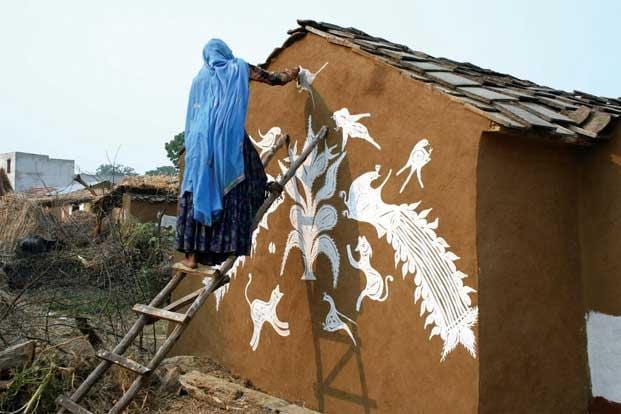
Meena women of Rajasthan draw images of nature and nurture—baby animals and birds with their mothers—on the walls of their houses, during harvest season. Photo: Madan Meena
Feminine strokes A photo exhibition by Tara Books showcases the journey of artworks by women, from households to galleries, ‘bazaars’ and books
The art that women make every day, as part of their lives, is difficult to define. Chennai-based indie feminist publisher Tara Books aims to showcase just this in a photography exhibition, Floor to Book: Women’s Everyday Art Traditions, starting on Saturday, International Women’s Day, in Chennai. “The women who make such art seldom see it as art. Neither do those who write about art imagine that household spaces are congenial to the making of ‘art’ as we understand it in the modern sense,” says V. Geetha, editorial director of Tara Books. For over a decade, the organization has been exploring the trajectory of indigenous art forms and their women practitioners from rural areas and tribal communities, bringing such work to the forefront through illustrations in its books.
This exhibition’s three sections—Everyday Art; Transitions; and The Book—will map the journey of these folk art forms. It will feature images of women making kolam outside homes in villages, towns and cities every day in Tamil Nadu; aripana from Bihar, done by Brahmin and Kayastha women during marriage and religious ceremonies; Bihar’s khobar wall art, done exclusively inside the bridal chamber; digna, drawn inside and outside homes in Madhya Pradesh’s Adivasi Gond region to mark the harvest season and other festivities; and mandna from Rajasthan, done by Meena women during the harvest season, before Diwali and Teej; Warli women in Maharashtra make warli art on walls during harvest season and weddings.
Most folk and tribal art is acknowledged to have emerged from such everyday art, says the exhibition brochure. Women, the custodians and torch-bearers of this tradition, beautify their homes—thresholds, floors, walls, alcoves, prayer spaces—as part of housework, which involves physical labour and commitment. It is one of the many things they do as a daily routine.
“We want to make a case for seeing women’s creative labour within the household as holding out possibilities for those women who wish to transcend their given roles, as mothers, wives, and for whom the making of art can hold out a moment of epiphany, happiness and self-fulfilment,” says Geetha, who has curated the exhibition along with her colleague and author Gita Wolf. While gods are invoked in aripana imagery, dignas stick to geometric and abstract designs, and kolams to dots and lines; most other imagery and motifs are part of the collective repertoire that women access by watching and learning from other women. Warli and khobar imagery has to do with fertility; Meena women draw images of nurture, baby animals and birds with their mothers. […]
[Bold typeface added above for emphasis] Do! is a set of action pictures, rendered in the Warli style of tribal art. It introduces basic verbs to the young reader through a series of brilliantly drawn pictograms, which illustrate the verb and tell a story. Source: SHOP | Tara Books Address : https://www.tarabooks.com/books/?product_search=do%21 Date Visited: Sun Nov 23 2014 12:04:21 GMT+0100 (CET)
Tara Books is an independent publisher of picture books for adults and children based in Chennai, South India. Founded in 1994, we remain a collective of dedicated writers, designers and artists who strive for a union of fine form with rich content. We continue to work with a growing tribe of adventurous people from around the world. Fiercely independent, we publish a select list that straddles diverse genres, offering our readers unusual and rare voices in art and literature.
Source: About the Tara Books team | Tara Books Address : http://www.tarabooks.com/about/ Date Visited: Sun Nov 23 2014 12:04:21 GMT+0100 (CET)