
Library copies: Worldcat.org >>
Gandhian social movement >>
“The tribal world and the tribal way is complete in itself.” – Mahasweta Devi quoted by Gopalkrishna Gandhi in “Swearing by Mahasweta” (The Hindu, 6 August 2016) | Backup (PDF, 450 KB) >>
The forest of languages and hope
Antara Dev Sen | Wednesday, March 10, 2010I have just planted a sapling with nice long leaves. […]. As they all grow up, they will make up the Bhasha Van — the forest of languages.
All 320 of them, with each tree representing an Indian language. Together, they would stand for the amazing linguistic diversity of our country, offering a forest of hope, reminding us of our rich cultural roots and our distinct identities.
Yes, there are hundreds of Indian languages. Thousands, if you are lenient with your definition of ‘language’. The 1961 census mentioned 1,652 mother tongues in India. But there is a matsyanyaya in language. Bigger, more powerful languages are swallowing up smaller ones, thus wiping out the identities of speakers of those mother tongues, creating language refugees who move to the dominant languages displaced from their beliefs, their cultural roots, their worldview, which were all embedded in their lost mother-tongue.
The Bhasha Van is an attempt to counter this dreadful cultural erosion. An initiative of the Bhasha Research and Publication Centre at Vadodara, this was part of the Bhasha Confluence that brought together 600 delegates from far-flung corners of the country. Participants ranged from the writer Mahasweta Devi, veteran Gandhian activist Narayanbhai Desai, linguist DP Pattanayak and several academics and activists, to hundreds of representatives of different tribal and minority languages and dialects. And of the 320-odd saplings planted at the Bhasha Van in the sprawling campus of the Adivasi Academy at Tejgarh, around 300 represented tribal languages. […]
Implementation of government policies is possibly our biggest problem. Failure of the government to deliver, especially in the tribal belt, is responsible for the rise of the Maoists. […]
Government policies need to reflect the fundamental importance of the mother tongue in education. […]
Source: The forest of languages and hope – Analysis – DNA
Address : https://www.dnaindia.com/analysis/column-the-forest-of-languages-and-hope-1357816
Date Visited: 13 September 2021
“The Big-brother attitude of educators must end. The approach to tribal education has to be a two-way transaction of give and take, based on an informed appreciation of traditional tribal values and wisdom.” – Uma Ram (Professor & Head Department of English, Kakatiya PG College, Chhattisgarh) in Issues in Tribal Education in Bastar, Chhattisgarh (Folklore Foundation, Lokaratna, Volume IV 2011)
Residential, Ashram and Factory schools
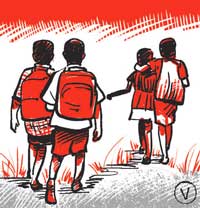
Ekalavya (Eklavya, Eklabya): the name of a legendary archer prodigy “who, being a Nishada [Sanskrit Niṣāda, “tribal, hunter, mountaineer, degraded person, outcast”], had to give his thumb as a fee to the brahmin guru thus terminating his skill as an archer.” – Romila Thapar (“The epic of the Bharatas”) | Read the full paper here | Backup download link (pdf) >>
More about India’s “Ekalavya Residential School Scheme”, “Ashram Schools” and “Factory schools”
Ekalavya Residential School Scheme (EMR): a network of boarding schools where tribal children are to be educated in accordance with rules and syllabi provided by the government; such schools are being designated as “Eklavya Model Residential School (EMR)” with the objective of empowering students “to be change agent, beginning in their school, in their homes, in their village and finally in a large context.” – Government Guidelines 2010 | Backup >>
Residential School and Ashram School
In some regions there are similar “Residential Schools” and “Ashram Schools” for tribal children, as in Tripura where they are managed by a society called “Tripura Tribal Welfare Residential Educational Institutions Society (TTWREIS)” – Tribal Welfare Department, Government of Tripura
Factory schools “exist to turn tribal and indigenous children – who have their own language and culture – into compliant workers-of-the-future. The world’s largest Factory School stated that it turns ‘Tax consumers into tax payers, liabilities into assets’.” – survivalinternational.org/factoryschools | Learn more >>
Learn more about Childrens rights: UNICEF India | Ekalavya (Eklavya, Eklabya), EMR & Factory schools | Rights of Indigenous Peoples >>
Tip: click on any red marker for details on endangered languages in a particular region of India.
Please note: facts and figures cited in map entries (via hyperlinks) often require updates (fact checking) | Cultural invisibility – India’s 600 potentially endangered languages | Linguistic Survey of India (official website) >>
[Bold typeface added above for emphasis]