PRASUN BHATTACHARYA, The Telegraph, March 19 , 2008
Rapid urbanisation in the hills is exposing the Bhutias to mounting levels of stress and increased risk of cardiovascular diseases, says a recently published study that contradicts the traditional belief that the members of the tribal community are characterised by their strong heart. […]
Lifestyle factors like fat-rich food, inadequate physical exercise and smoking are known to cause cardiovascular diseases. Tribal populations, especially the ones living in the mountains, are usually thought to be free of these diseases as they follow a different lifestyle that includes a lot of physical activity.
The ISI study, however, paints a different picture.
Mukhopadhyay and researcher Sobhanjan Sarkar conducted the study in Sikkim on 428 Bhutias, aged 20 years and above, from both sexes and living in rural and urban settings. They chose one ethnic group to maintain the homogeneity of the study. The Bhutias are also the largest single group living in both urban and rural areas. […]
Source: The Telegraph – Calcutta (Kolkata) | North Bengal & Sikkim | ‘Vices’ of urban lifestyle put hill tribe at health risk
Address : http://www.telegraphindia.com/1080319/jsp/siliguri/story_9033933.jsp
Date Visited: Wed Apr 25 2012 16:42:07 GMT+0200 (CEST)
“It was assumed that tribal people have same health problems, similar needs and hence the uniform national pattern of rural health care would be applicable to them as well, albeit with some alteration in population: provider ratio. The different terrain and environment in which they live, different social systems, different culture and hence different health care needs were not addressed.”– Abhay Bang, Chairman, Expert Committee on Tribal health (2018 Report of the Expert Committee on Tribal Health) | Learn more >>
Download Tribal Health in India PDF (35 MB) >>
Searchable file (backup): PDF (OCR 70 MB) >>
Context | Health care for communities identified as “poorest of poor” (PVTGs)
India is designated as the melting pot of so many ethnic groups dwelling at the same time under the common umbrella of a unified nation. Among these varied ethnic groups, some of them have been categorized under article 342 (1) of the constitution and have been labelled as Scheduled Tribe. In the post independent scenario, several schemes for upliftment of STs were run by the government but it was found that all these groups did not come up to the same level of development. Some of them were at much lower strata than others. Thus, in order to ensure the development of these communities, they were, for the first time in 1975-76 (during 5th Five-year plan) and thereafter-in 1993, identified as poorest of poor among the STs and were designated as Primitive Tribal Groups and thereafter constitution of India renamed and declared as Particularly Vulnerable Tribal Groups (PVTGs). Out of the 75 particularly vulnerable tribal groups, 13 are residing in Odisha; they are becoming increasing vulnerable due to loss of their customary habitat. The health troubles of rural areas especially in the tribal areas need a unique concentration, because the tribal people have typical health problem.
Source: 2019 PhD thesis (Abstract) by Jayanta Kumar Nayak titled “Health Seeking Behaviour and Health Care Services among the Hill Kharia Mayurbhanj District Odisha”, Department of Anthropology, Central University of Orissa
URL: http://hdl.handle.net/10603/257651
Date Visited: 21 May 2025
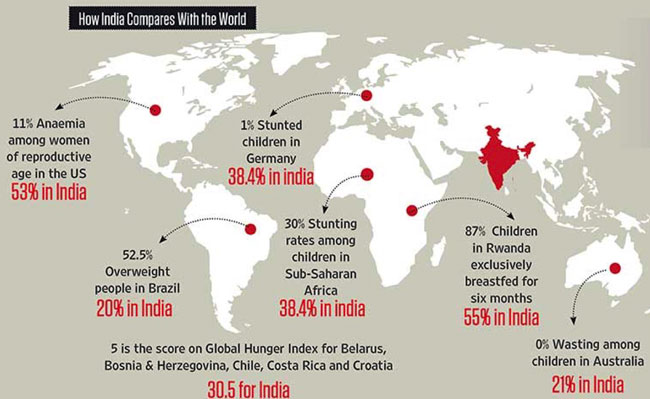
Graphic © Outlook India 26 August 2019 >>
The tribal food basket has always been diverse and nutritious >>
Childrens rights: UNICEF India | Childrens right to education >>
Health spending by the Indian government
“Health spending by the Indian government as percentage of GDP has long been one of the lowest for any major country, and the public health system is chronically dismal.” – Pranab Bardhan in “The two largest democracies in the world are the sickest now” | Learn more: Scroll.in, 24 August 2020 >>
Context | Health care for communities identified as “poorest of poor” (PVTGs)
India is designated as the melting pot of so many ethnic groups dwelling at the same time under the common umbrella of a unified nation. Among these varied ethnic groups, some of them have been categorized under article 342 (1) of the constitution and have been labelled as Scheduled Tribe. In the post independent scenario, several schemes for upliftment of STs were run by the government but it was found that all these groups did not come up to the same level of development. Some of them were at much lower strata than others. Thus, in order to ensure the development of these communities, they were, for the first time in 1975-76 (during 5th Five-year plan) and thereafter-in 1993, identified as poorest of poor among the STs and were designated as Primitive Tribal Groups and thereafter constitution of India renamed and declared as Particularly Vulnerable Tribal Groups (PVTGs). Out of the 75 particularly vulnerable tribal groups, 13 are residing in Odisha; they are becoming increasing vulnerable due to loss of their customary habitat. The health troubles of rural areas especially in the tribal areas need a unique concentration, because the tribal people have typical health problem.
Source: 2019 PhD thesis (Abstract) by Jayanta Kumar Nayak titled “Health Seeking Behaviour and Health Care Services among the Hill Kharia Mayurbhanj District Odisha”, Department of Anthropology, Central University of Orissa
URL: http://hdl.handle.net/10603/257651
Date Visited: 21 May 2025
Factchecker.in | Safe search examples with keywords:
“tribal rights unesco“ | “rural india unesco“ | “tribal education india unesco“
“The per capita consumption of alcohol for India is 4 litres […] A study conducted by the Alcohol & Drug Information Centre (ADIC) – India revealed that around 40 per cent of road accidents occurred because the driver was under the influence of alcohol. In the case of accidents on national highways, more than 72 per cent were related to drunken driving. Domestic violence is also on the increase due to high alcohol consumption. Alcohol related diseases are growing leading to high occupancy of hospital beds in hospitals.” – Learn more: Human Development Report 2005 Kerala, Government of Kerala (2006) >>