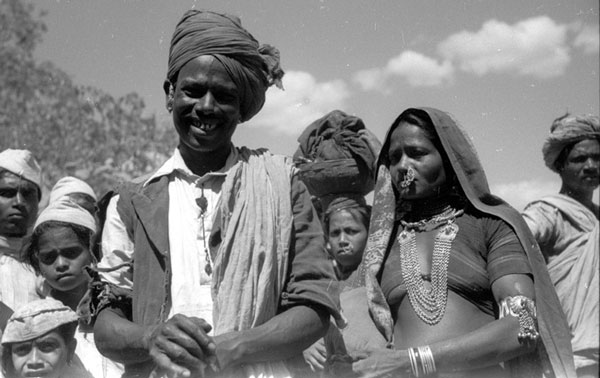
Learn more about this photo and the Bhil community >>
The Bhil tribe is a proud and ancient ethnic group inhabiting the Western part of Central India with the highest concentration in Jhabua district of Madhya Pradesh State. | Read more >>
The western region is home to a wide variety of people with different religious ‘s and cultures, most of whom have distinctive traditional textiles. They include Jains, Parsis, Hindus and Muslims, as well as tribal groups such as the Bhils and Mina. This region’s propensity toward colour has deep roots, for it is here that the Indus Valley civilization developed cotton-growing and -dyeing technologies. From at least the early second millennium AD, western India has traded dyed textiles to the Middle East, South-East Asia and the Far East, and later to Europe and the Americas, although most local communities maintained their own textile designs. | Learn more about western India’s cotton-growing and -dyeing technologies >>
The Bhils are probably the descendants of some of the original inhabitants of India known as the ‘aborigines’ or Scheduled Tribes (Adivasis), who now comprise only about eight per cent of the population of India. The rest, 92 per cent, consists of descendants of immigrants. Thus India is broadly a country of immigrants, like North America. […]
India was a veritable paradise for pastoral and agricultural societies because it has level and fertile land, with hundreds of rivers, forests, etc., and is rich in natural resources. Hence for thousands of years people kept pouring into India because they found a comfortable life here in a country which was gifted by nature. | Excerpt from a Supreme Court judgment published by The Hindu >>
The Community Forest Resource (CFR) rights provisions of the Scheduled Tribes and Other Traditional Forest Dwellers (Recognition of Forest Rights) Act, 2006 (also known as the Forest Rights Act) is a revolutionary tool in forest governance. It visualizes statutorily backed devolution of forest management authority to Gram Sabhas, and full transfer of rights over non-timber forest products to them. The CFR provision gives local communities the right to protect, regenerate or conserve or manage any community forest resource which the communities have been traditionally protecting and conserving for sustainable use. It further has the potential to bring about a transformative change in the economic and social conditions of the local people, and improve the management of the forests.
Besides North-east India, the highest concentration of Scheduled tribes is in Central India. Additionally, Madhya Pradesh, Chhattisgarh, Maharashtra, and Jharkhand are among the top ten states with respect to forest areas. But, barring Maharashtra the CFR [Community Forest Resource] implementation status is very poor in these neighboring states. To address this lack of large-scale on-ground implementation of CFR provisions, this study will try to identify the major hurdles and enabling factors in CFR implementation and CFR management in Maharashtra and other Central Indian states, develop policy recommendations and guidelines to remediate it and further suggest better CFR management practices.
Source: Project description titled “Action Research and Policy Support on Community Forest Resource management in Central India” by Ashoka Trust for Research in Ecology and the Environment (ATREE)
URL: https://www.atree.org/projects/action-research-and-policy-support-community-forest-resource-management-central-india
Date Visited: 5 July 2021
Up-to-date reports by Indian experts and journalists
Search tips
Combine the name of any particular state, language or region with that of any tribal (Adivasi) community.
Add keywords of special interest (music, poetry, dance just as health, sacred grove and biodiversity); learn about the rights of Scheduled Tribes such as the “Forest Rights Act” (FRA); and the United Nations “Declaration on the Rights of Indigenous Peoples”, “Universal Declaration of Human Rights”, “women’s rights”, or “children’s right to education”.
Ask a question that includes “tribal” or “Adivasi”, for instance: “Adivasi way of life better?” (or “tribal way of life worse?”)
Specify any particular issue or news item (biodiversity, bonded labour and human trafficking, climate change, ecology, economic development, ethnobotany, ethnomedicine, global warming, hunter-gatherers in a particular region or state, prevention of rural poverty, water access).
For official figures include “scheduled tribe ST” along with a union state or region: e.g. “Chhattisgarh ST community”, “Himalayan tribe”, “Scheduled tribe Tamil Nadu census”, “ST Kerala census”, “Particularly Vulnerable Tribal Group Jharkhand”, “PVTG Rajasthan”, “Adivasi ST Kerala”, “Adibasi ST West Bengal” etc.
SafeSearch browser tips
If your (mobile) browser fails to display “embedded” media contents, Google maps and SafeSearch windows
Try another browser like Firefox, Chrome or Safari available on your device
Ensure your favourite browser is up to date
Close your present browser
Check your browser and mobile (gsm) settings:
e.g. permission for video or JavaScript
(seen under Preferences >Security >Enable JavaSript)
Restart your computer (smartphone, tablet)
Reconnect to your wifi network or connect to a different one
On some iPhone models the following helps:
>Settings >Safari >scroll down to:
SETTING FOR WEBSITES
Enable “Request Desktop Website” (All Websites) temporarily
Return to the map-post in Safari and “Reload”
Return to >Settings and disable “Request Desktop Website” again
Return to the post in Safari and “Reload”which should now display “embedded” contents as intended (with the convenience of browsing the mobile version on a small screen)
Note: similar solutions may also work with other mobile operating systems.
List of websites covered by this Google custom search engine
Academia.edu (platform for academics to share research papers) – www.academia.edu
Archive.org – https://archive.org
Centre for Science and Environment – https://www.cseindia.org
Current Conservation – https://www.currentconservation.org
Development and Cooperation (D+C) https://www.dandc.eu
Down To Earth (India) – www.downtoearth.org.in
India Environment Portal – www.indiaenvironmentportal.org.in
Harnessing Nature Magazine – https://harnessingnature.online
Mongabay-India – https://india.mongabay.com
M S Swaminathan Research Foundation – www.mssrf.org
Navdanya (protecting India’s biodiversity based food heritage) – https://navdanya.org
People’s Archive of Rural India – https://ruralindiaonline.org/
Third World Network (Penang, Malaysia) – https://twn.my
The Shola Trust (nature conservation in the Nilgiri region) – www.thesholatrust.org
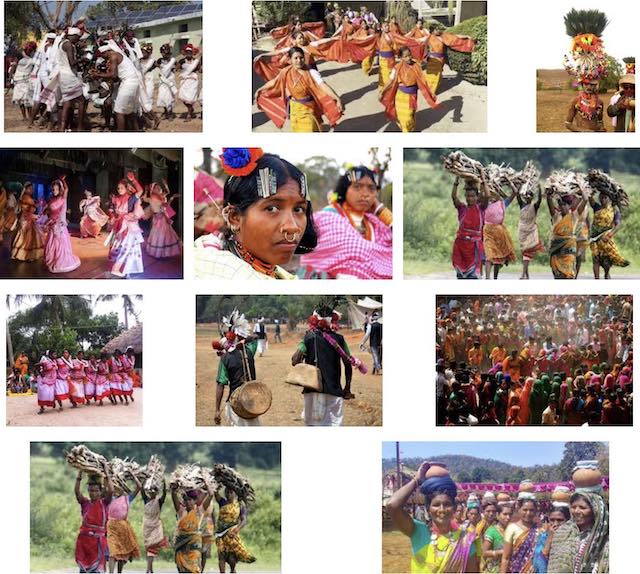
Indian online periodicals and platforms | Images view >>
~ ~ ~
Personalize your CustomSearch by combining other search words >>
(e.g. name of a tribal community and region, a craft, or dance and puppetry)
Research: explore PhD theses from all over India
Shodhganga (Open Access)