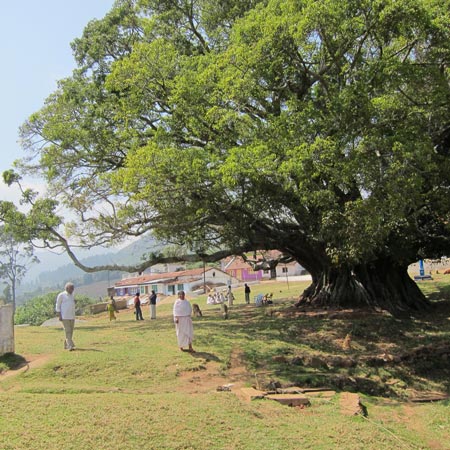
 The inhabitants of remote Kunda Kotagiri village maintain their own culture centre. This ensures the continuance of their community’s distinct traditions among the educated youth of this village. Such enthusiasm was much in evidence during this unannounced visit which was facilitated by Mr. Raman, himself a Kota residing in a another village. The women are in charge of a village healthcare centre in conjunction with the “Village Health Worker Project”; this is sponsored by theTribal Integrated Development and Educational Trust (Mumbai).
Media contents
- Shivaratri celebrations by the Kota community in the Nilgiri mountains – Tamil Nadu
- Watch a festival dance demonstration by women of the Kota community
Kotas or Kothar or Kov by self-designation are an ethnic group who are indigenous to the Nilgiris mountain range in Tamil Nadu, India. They are one of the many tribal or ethnic groups indigenous to the region. […]
Since the 1930s through the efforts of a Kota school teacher, social reformer and activist named Sulli Kota and his followers, Kotas have transformed their previous traditional relationships away from serving other so called high prestige ethnic groups and upgraded their socio-economic status.[4] They no longer practice any of their traditional service functions.[1] […]
Although many theories have been put forth as to the origins of Kotas and Todas, none have been confirmed as factual. What linguists and anthropologists agree is that ancestors of both Kotas and Todas may have entered the Nilgiris massif from what is today Kerala or Karnataka in centuries BCE and developed in isolation from the rest of the society. […]
Further reading
Wolf, Richard (2006), The Black Cow’s Footprint: Time, Space and Music in the Lives of the Kotas of South India, University of Illinois Press, ISBN 0252031164
Source: Kotas – Wikipedia, the free encyclopedia
Address : http://en.wikipedia.org/wiki/Kotas#External_links
Date Visited: Thu Aug 11 2011 13:09:54 GMT+0200 (CEST)
Related posts
Research: explore PhD theses from all over India
Shodhganga (Open Access)
Search Worldcat.org for publications by reputed authors (select “Open Content/Open Access” for freely downloadable content)
Search tips
Combine the name of any particular state, language or region with that of any tribal (Adivasi) community.
Ask a question that includes “tribal” or “Adivasi”, for instance: “Adivasi way of life better?” (or “tribal way of life worse?”)
Add keywords of special interest (music, poetry, dance just as health, sacred grove and biodiversity); learn about the rights of Scheduled Tribes such as the “Forest Rights Act” (FRA); and the United Nations “Declaration on the Rights of Indigenous Peoples”, “Universal Declaration of Human Rights”, “women’s rights”, or “children’s right to education”.
Specify any particular issue or news item (biodiversity, bonded labour and human trafficking, climate change, ecology, economic development, ethnobotany, ethnomedicine, global warming, hunter-gatherers in a particular region or state, prevention of rural poverty, water access).