India’s ambitious ‘Zero Hunger’ program will be launched in three districts – Gorakhpur in Uttar Pradesh, Koraput in Odisha and Thane in Maharashtra on October 16, the World Food Day.
The Program will be initiated by Indian Council of Agricultural Research (ICAR) in association with Indian Council of Medical Research (ICMR), MS Swaminathan Research Foundation and Biotechnology Industry Research Assistance Council (BIRAC). Zero Hunger − pledges to end hunger, achieve food security, improve nutrition and promote sustainable agriculture, and is the priority of the World Food Programme.
Source: Current Affairs September 2017 – National
URL: https://www.tutorialspoint.com/current_affairs_september_2017/national.htm
Date visited: 12 June 2018
“Hunger” and “undernutrition” amidst widening wealth disparity
In a discussion with Subhoranjan Dasgupta, Professor Patnaik, a distinguished economist from JNU, explores the widening wealth disparity and how a focus on GDP can be used to legitimise transfers to crony capitalists. […]
The MPI [Multidimensional Poverty Index]is a weighted index using criteria for a household to be considered non-poor, like access to piped water, non-thatched dwelling (which could be merely a one room hut with a metal roof), toilet; having a bank account (whether or not the balance is zero); it gives only one-sixth weight to what is misleadingly called a nutrition indicator, namely the body mass index (BMI), which does not actually measure nutritional status. Since it is a ratio (weight in kilograms divided by the square of height in metres), it can have exactly the same value for persons of normal weight and height, as for persons of the same age who are seriously undernourished and stunted. Even the latter, therefore, would not be considered poor. […]
The last half-century of colonial rule had seen an immense increase in nutritional poverty in British India, which was reversed, though not fully, by strenuous efforts of the post-independence governments prior to the introduction of neo-liberalism in the early 1990s. […] Even the National Family Health Survey, whose data are used by the MPI, shows that the prevalence of anaemia among women aged 15-49 rose from 53% in 2015-16 to 58% in 2019-21. Hunger and undernutrition are stalking the country. India today is worse placed than both Sub-Saharan Africa and the “Least Developed Countries”.
Source: ‘Hunger, Undernutrition Stalking India; Placed Worse Than Least Developed Nations’: Prabhat Patnaik by Subhoranjan Dasgupta, The Wire, 19 January 2024
URL: https://thewire.in/economy/hunger-undernutrition-stalking-india-placed-worse-than-least-developed-nations-prabhat-patnaik
Date Visited: 21 January 2024
More than 250 million Indians remain food insecure, ingesting less than 2,100 calories every day
Varun Gandhi, Hindustani Times, 20 April 2018
The stories from India’s hinterland on hunger are woeful in themselves. […]
More than 14.5% of our population is considered as undernourished, says the Global Hunger Index, 2017, with 21% children suffering from acute malnutrition, while 38.4% of children under the age of five suffer from stunting. This is reflected in the height of our children (children born in India are on average shorter than those in sub-Saharan Africa). More than 250 million Indians remain food insecure, ingesting less than 2,100 calories every day. As the Planning Commission put it in the Human Development Report, 2012: “If India is not in a state of famine, it is quite clearly in a state of chronic hunger.”
Source: Fighting hunger is India’s greatest challenge
URL: https://www.hindustantimes.com/analysis/fighting-hunger-is-india-s-greatest-challenge/story-1UBa5bIKbS094GpXnKQIAI.html
Date visited: 7 October 2018
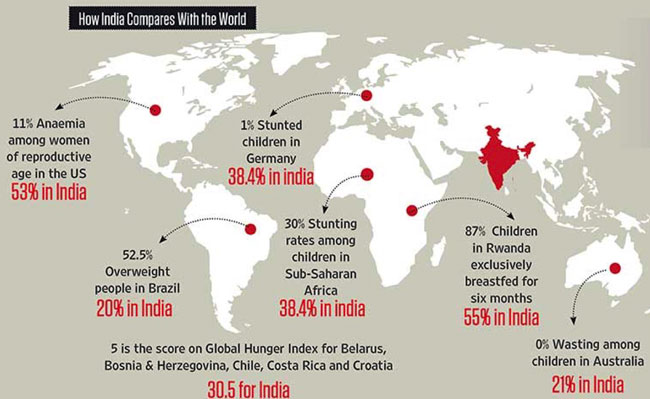
Graphic © Outlook India 26 August 2019 >>
The tribal food basket has always been diverse and nutritious >>
Childrens rights: UNICEF India | Childrens right to education >>
“The tribal food basket has always been diverse and nutritious”
The tribal food basket has always been diverse and nutritious, including maize, minor millets like kodo and kutki, oil seeds like ramtila, along with fruits, leaves, rhizomes, mushrooms, meat and fish […] We have pushed them out of their complementary relationship with ecology, way of life and time-tested nutrition. | Learn more >>
Forest Lanterns
India has over 11 million tribal children, and 4.9 million of them are chronically undernourished. Forest Lanterns is a collection of invited essays on forty-six solutions from solution seekers working on the ground to improve the nutrition of tribal children from nine states (Andhra Pradesh, Chhattisgarh, Gujarat, Jharkhand, Madhya Pradesh, Maharashtra, Odisha, Rajasthan and Telangana) in India. With contributions from the who’s who of policymakers, bureaucrats, practitioners and experts, the essays conclude with key takeaways for doers for replicating or scaling-up these change initiatives.
Source: Forest Lanterns
URL: http://penguin.co.in/enterprise/forest-lanterns/
Date visited: 12 June 2018
Up-to-date reports by Indian experts and journalists
List of sites covered by this Google SafeSearch engine
Academia.edu (platform for academics to share research papers) – www.academia.edu
Archive.org – https://archive.org
Centre for Science and Environment – https://www.cseindia.org
Current Conservation – https://www.currentconservation.org
Development and Cooperation (D+C) https://www.dandc.eu
Down To Earth (India) – www.downtoearth.org.in
India Environment Portal – www.indiaenvironmentportal.org.in
Harnessing Nature Magazine – https://harnessingnature.online
Kalpavriksh Environmental Action Group – https://kalpavriksh.org
Mongabay-India – https://india.mongabay.com
M S Swaminathan Research Foundation – www.mssrf.org
Navdanya (protecting India’s biodiversity based food heritage) – https://navdanya.org
People’s Archive of Rural India – https://ruralindiaonline.org/
Third World Network (Penang, Malaysia) – https://twn.my
The Shola Trust (nature conservation in the Nilgiri region) – www.thesholatrust.org
TribalConnect (“uplift and benefit the community without adversely affecting or changing their vernacular”) – https://tribalconnect.org.in
WorldCat (“the world’s largest library catalog, helping you find library materials online”) – https://worldcat.org
More SafeSearch on this website
Search tips
Combine the name of any particular state, language or region with that of any tribal (Adivasi) community.
Add keywords of special interest (music, poetry, dance just as health, sacred grove and biodiversity); learn about the rights of Scheduled Tribes such as the “Forest Rights Act” (FRA); and the United Nations “Declaration on the Rights of Indigenous Peoples”, “Universal Declaration of Human Rights”, “women’s rights”, or “children’s right to education”.
Ask a question that includes “tribal” or “Adivasi”, for instance: “Adivasi way of life better?” (or “tribal way of life worse?”)
Specify any particular issue or news item (biodiversity, bonded labour and human trafficking, climate change, ecology, economic development, ethnobotany, ethnomedicine, global warming, hunter-gatherers in a particular region or state, prevention of rural poverty, water access).
For official figures include “scheduled tribe ST” along with a union state or region: e.g. “Chhattisgarh ST community”, “Himalayan tribe”, “Scheduled tribe Tamil Nadu census”, “ST Kerala census”, “Particularly Vulnerable Tribal Group Jharkhand”, “PVTG Rajasthan”, “Adivasi ST Kerala”, “Adibasi ST West Bengal” etc.
SafeSearch browser tips
If your (mobile) browser fails to display “embedded” media contents, Google maps and SafeSearch windows
Try another browser like Firefox, Chrome or Safari available on your device
Ensure your favourite browser is up to date
Close your present browser
Check your browser and mobile (gsm) settings:
e.g. permission for video or JavaScript
(seen under Preferences >Security >Enable JavaSript)
Restart your computer (smartphone, tablet)
Reconnect to your wifi network or connect to a different one
On some iPhone models the following helps:
>Settings >Safari >scroll down to:
SETTING FOR WEBSITES
Enable “Request Desktop Website” (All Websites) temporarily
Return to the map-post in Safari and “Reload”
Return to >Settings and disable “Request Desktop Website” again
Return to the post in Safari and “Reload”which should now display “embedded” contents as intended (with the convenience of browsing the mobile version on a small screen)
Note: similar solutions may also work with other mobile operating systems.
What does it mean to be Indigenous?
Indigenous Peoples can be identified according to certain characteristics:
They are politically and socially marginalized.
Most importantly, they self-identify as Indigenous Peoples.
They share an ancestral link with those who inhabited a country or region before they were colonized or before other peoples became dominant.
They have a strong link to particular territories and the surrounding natural resources.
They have distinct social, economic or political systems, which they are resolved to maintain and reproduce.
They have a distinct language, culture and beliefs.
There are more than 5,000 different Indigenous Peoples around the world comprising 476 million people – around 6.2% of the global population. They are spread across more than 90 countries in every region and speak more than 4,000 languages. | Learn more (Amnesty International) >>
Source: “INDIGENOUS PEOPLES’ RIGHTS” by Amnesty International
URL: https://www.amnesty.org/en/what-we-do/indigenous-peoples/
Date Visited: 10 May 2025
Learn more on the Rights of Indigenous Peoples, their Languages & linguistic heritage & Tribal culture worldwide >>