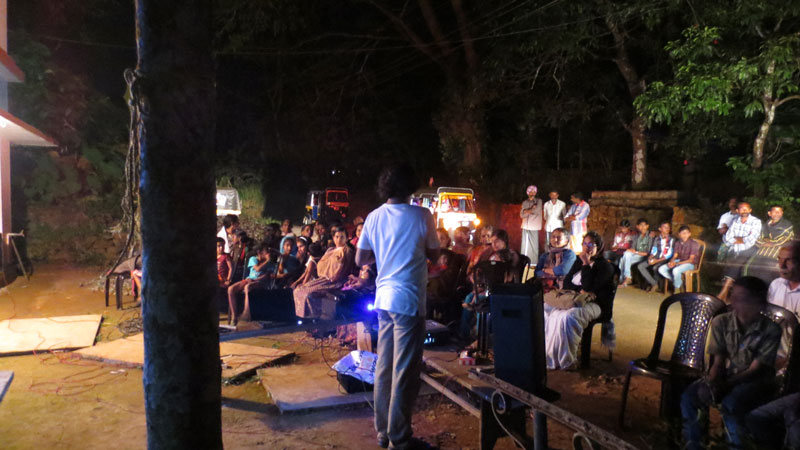
Report on community screenings (2013-14)
A trial series of community screenings coordinated by FERNS took place in collaboration with initiatives that meet the following criteria:
- Scope for entrusting young tribals with social responsibilities (e.g. Thrissileri, Pavana Center and tribal residential schools)
- Having facilities like a public library that attract local people for discussions (e.g. Gjaanodaya Vaayanashala and Kulangod)
- Providing a social and political space where tribals feel confident enough to intervene
- Availability of local knowledge in tribal colonies
Results and benefits
The community screenings have made local people aware of the need for educational activities on ecology. Each tribal facilitator in the community screening project approached the project differently. Some used used the opportunity to intervene in their own community space. They now realize what it means if traditional food cultures are lost. They have also become aware of the need to improve their knowledge about edible roots and mushrooms growing right there, in their own surroundings. As for the medicinal plants mentioned by Ramettan and Jochi Chechi in the “Arana” documentary, they exemplify local knowledge that, although still valued, remains in danger of being lost. All agree that something has to be done in order to ensure its continuity. Cheruvayal Raman and Jochi Chechi, the main persons portrayed in the “Arana” documentary, have resumed their lives as ordinary people after the film was made over a period of five years. Their efforts to understand and protect their environment as part of daily life have inspired the tribal facilitators.
Future plans
More community screenings are being planned. The women facilitators became more confident after each community screening session. One of them, Devaki, has become actively involved in Mahila Samakhya (NGO working for the empowerment of women). She plans screening the “Arana” documentary for members in different places. Their ambition is to take up the community screening project to a higher level. Their involvement in the community screenings convinced them that this documentary should be screened in all public libraries across Kerala and women’s self help groups. Their ooperation is helpful in efforts by FERNS, namely to focus on tribal and environmental issues together rather than separately.
Source: Email by Arun P.A., Secretary of the FERNS Naturalists Society, Mananthavady (Wayanad) 22 February 2014
“Tribal communities are a standing example of how women play a major role in preservation of eco historic cultural heritage in India.” – Mari Marcel Thekaekara (writer and Co-Founder of ACCORD-Nilgiris) | Learn more >>
Up-to-date reports by Indian experts and journalists
List of sites covered by this Google SafeSearch engine
Academia.edu (platform for academics to share research papers) – www.academia.edu
Archive.org – https://archive.org
Centre for Science and Environment – https://www.cseindia.org
Current Conservation – https://www.currentconservation.org
Development and Cooperation (D+C) https://www.dandc.eu
Down To Earth (India) – www.downtoearth.org.in
India Environment Portal – www.indiaenvironmentportal.org.in
Harnessing Nature Magazine – https://harnessingnature.online
Kalpavriksh Environmental Action Group – https://kalpavriksh.org
Mongabay-India – https://india.mongabay.com
M S Swaminathan Research Foundation – www.mssrf.org
Navdanya (protecting India’s biodiversity based food heritage) – https://navdanya.org
People’s Archive of Rural India – https://ruralindiaonline.org/
Third World Network (Penang, Malaysia) – https://twn.my
The Shola Trust (nature conservation in the Nilgiri region) – www.thesholatrust.org
TribalConnect (“uplift and benefit the community without adversely affecting or changing their vernacular”) – https://tribalconnect.org.in
WorldCat (“the world’s largest library catalog, helping you find library materials online”) – https://worldcat.org
More SafeSearch on this website
Search tips
Combine the name of any particular state, language or region with that of any tribal (Adivasi) community.
Add keywords of special interest (music, poetry, dance just as health, sacred grove and biodiversity); learn about the rights of Scheduled Tribes such as the “Forest Rights Act” (FRA); and the United Nations “Declaration on the Rights of Indigenous Peoples”, “Universal Declaration of Human Rights”, “women’s rights”, or “children’s right to education”.
Ask a question that includes “tribal” or “Adivasi”, for instance: “Adivasi way of life better?” (or “tribal way of life worse?”)
Specify any particular issue or news item (biodiversity, bonded labour and human trafficking, climate change, ecology, economic development, ethnobotany, ethnomedicine, global warming, hunter-gatherers in a particular region or state, prevention of rural poverty, water access).
For official figures include “scheduled tribe ST” along with a union state or region: e.g. “Chhattisgarh ST community”, “Himalayan tribe”, “Scheduled tribe Tamil Nadu census”, “ST Kerala census”, “Particularly Vulnerable Tribal Group Jharkhand”, “PVTG Rajasthan”, “Adivasi ST Kerala”, “Adibasi ST West Bengal” etc.
SafeSearch browser tips
If your (mobile) browser fails to display “embedded” media contents, Google maps and SafeSearch windows
Try another browser like Firefox, Chrome or Safari available on your device
Ensure your favourite browser is up to date
Close your present browser
Check your browser and mobile (gsm) settings:
e.g. permission for video or JavaScript
(seen under Preferences >Security >Enable JavaSript)
Restart your computer (smartphone, tablet)
Reconnect to your wifi network or connect to a different one
On some iPhone models the following helps:
>Settings >Safari >scroll down to:
SETTING FOR WEBSITES
Enable “Request Desktop Website” (All Websites) temporarily
Return to the map-post in Safari and “Reload”
Return to >Settings and disable “Request Desktop Website” again
Return to the post in Safari and “Reload”which should now display “embedded” contents as intended (with the convenience of browsing the mobile version on a small screen)
Note: similar solutions may also work with other mobile operating systems.
What does it mean to be Indigenous?
Indigenous Peoples can be identified according to certain characteristics:
They are politically and socially marginalized.
Most importantly, they self-identify as Indigenous Peoples.
They share an ancestral link with those who inhabited a country or region before they were colonized or before other peoples became dominant.
They have a strong link to particular territories and the surrounding natural resources.
They have distinct social, economic or political systems, which they are resolved to maintain and reproduce.
They have a distinct language, culture and beliefs.
There are more than 5,000 different Indigenous Peoples around the world comprising 476 million people – around 6.2% of the global population. They are spread across more than 90 countries in every region and speak more than 4,000 languages. | Learn more (Amnesty International) >>
Source: “INDIGENOUS PEOPLES’ RIGHTS” by Amnesty International
URL: https://www.amnesty.org/en/what-we-do/indigenous-peoples/
Date Visited: 10 May 2025
Learn more on the Rights of Indigenous Peoples, their Languages & linguistic heritage & Tribal culture worldwide >>
View Tribal Cultural Heritage in India Foundation in a larger map