
[24:50] We are a colonized people. But there’s always the extended family. […] In our world either the aunty takes them or it’s the grandmother. We raise the grandkids. | Download and listen as podcast (27:25) >>
Subscribe to the podcast: iTunes | Spotify | RSS

The Braveheart Women’s Society, a group of Yankton Sioux grandmothers and tribal elders, have re-established an almost forgotten coming of age ritual for young girls—the Isnati, a four day traditional ceremony on the banks of the Missouri River in South Dakota. This year the 24th Isnati ceremony took place. […]
We hear from grandmothers Faith Spotted Eagle, Theresa Heart, and Madonna Thunder Hawk who speak about Indian boarding schools, activism, and the importance of re-establishing traditions and rituals in their community.
Special thanks to the grandmothers, Brook Spotted Eagle and all the young women who have participated in the Isnati Coming of Age Ceremony. Thanks also to the WoLakota Project.
Source: “The Braveheart Grandmothers and Yankton Sioux Coming of Age Ceremony” by Davia Nelson & Nikki Silva >>
URL: http://www.kitchensisters.org/present/the-braveheart-grandmothers/
Date Visited: 6 October 2021
“The Big-brother attitude of educators must end. The approach to tribal education has to be a two-way transaction of give and take, based on an informed appreciation of traditional tribal values and wisdom.” – Uma Ram (Professor & Head Department of English, Kakatiya PG College, Chhattisgarh) in Issues in Tribal Education in Bastar, Chhattisgarh (Folklore Foundation, Lokaratna, Volume IV 2011)
Residential, Ashram and Factory schools
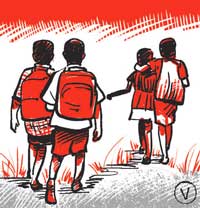
Ekalavya (Eklavya, Eklabya): the name of a legendary archer prodigy “who, being a Nishada [Sanskrit Niṣāda, “tribal, hunter, mountaineer, degraded person, outcast”], had to give his thumb as a fee to the brahmin guru thus terminating his skill as an archer.” – Romila Thapar (“The epic of the Bharatas”) | Read the full paper here | Backup download link (pdf) >>
More about India’s “Ekalavya Residential School Scheme”, “Ashram Schools” and “Factory schools”
Ekalavya Residential School Scheme (EMR): a network of boarding schools where tribal children are to be educated in accordance with rules and syllabi provided by the government; such schools are being designated as “Eklavya Model Residential School (EMR)” with the objective of empowering students “to be change agent, beginning in their school, in their homes, in their village and finally in a large context.” – Government Guidelines 2010 | Backup >>
Residential School and Ashram School
In some regions there are similar “Residential Schools” and “Ashram Schools” for tribal children, as in Tripura where they are managed by a society called “Tripura Tribal Welfare Residential Educational Institutions Society (TTWREIS)” – Tribal Welfare Department, Government of Tripura
Factory schools “exist to turn tribal and indigenous children – who have their own language and culture – into compliant workers-of-the-future. The world’s largest Factory School stated that it turns ‘Tax consumers into tax payers, liabilities into assets’.” – survivalinternational.org/factoryschools | Learn more >>
Learn more about Childrens rights: UNICEF India | Ekalavya (Eklavya, Eklabya), EMR & Factory schools | Rights of Indigenous Peoples >>
Tip: click on any red marker for details on endangered languages in a particular region of India.
Please note: facts and figures cited in map entries (via hyperlinks) often require updates (fact checking) | Cultural invisibility – India’s 600 potentially endangered languages | Linguistic Survey of India (official website) >>