When Doris and Esther came home during the summer months, they felt alienated from their family. The residential school taught them to feel ashamed of their language and culture, and to disrespect their Cree-speaking parents. (Lorena Fontaine)
To listen and view a series of photos, click here >>
Lorena Fontaine is battling to revive aboriginal languages — languages that have been quashed and brought to the brink of extinction by Canada’s residential school system. She is completing her PhD at the University of Manitoba, and argues that Canadian Indigenous communities have a legal right to the survival of language. For her, it’s a race against time that must not be lost.
Source: Undoing Linguicide: The legal right to the survival of Indigenous languages – Home | Ideas with Paul Kennedy | CBC Radio
Address: http://www.cbc.ca/radio/ideas/undoing-linguicide-the-legal-right-to-the-survival-of-indigenous-languages-1.3525609
Date Visited: Mon Aug 07 2017 15:08:23 GMT+0200 (CEST)
Search Worldcat.org for publications by reputed authors (select “Open Content/Open Access” for freely downloadable content)
Search tips
Combine the name of any particular state, language or region with that of any tribal (Adivasi) community.
Ask a question that includes “tribal” or “Adivasi”, for instance: “Adivasi way of life better?” (or “tribal way of life worse?”)
Add keywords of special interest (music, poetry, dance just as health, sacred grove and biodiversity); learn about the rights of Scheduled Tribes such as the “Forest Rights Act” (FRA); and the United Nations “Declaration on the Rights of Indigenous Peoples”, “Universal Declaration of Human Rights”, “women’s rights”, or “children’s right to education”.
Specify any particular issue or news item (biodiversity, bonded labour and human trafficking, climate change, ecology, economic development, ethnobotany, ethnomedicine, global warming, hunter-gatherers in a particular region or state, prevention of rural poverty, water access).
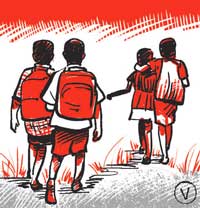
Ekalavya (Eklavya, Eklabya): the name of a legendary archer prodigy “who, being a Nishada [Sanskrit Niṣāda, “tribal, hunter, mountaineer, degraded person, outcast”], had to give his thumb as a fee to the brahmin guru thus terminating his skill as an archer.” – Romila Thapar (“The epic of the Bharatas”) | Read the full paper here | Backup download link (pdf) >>
More about India’s “Ekalavya Residential School Scheme”, “Ashram Schools” and “Factory schools”
Ekalavya Residential School Scheme (EMR): a network of boarding schools where tribal children are to be educated in accordance with rules and syllabi provided by the government; such schools are being designated as “Eklavya Model Residential School (EMR)” with the objective of empowering students “to be change agent, beginning in their school, in their homes, in their village and finally in a large context.” – Government Guidelines 2010 | Backup >>
Residential School and Ashram School
In some regions there are similar “Residential Schools” and “Ashram Schools” for tribal children, as in Tripura where they are managed by a society called “Tripura Tribal Welfare Residential Educational Institutions Society (TTWREIS)” – Tribal Welfare Department, Government of Tripura
Factory schools “exist to turn tribal and indigenous children – who have their own language and culture – into compliant workers-of-the-future. The world’s largest Factory School stated that it turns ‘Tax consumers into tax payers, liabilities into assets’.” – survivalinternational.org/factoryschools | Learn more >>
Learn more about Childrens rights: UNICEF India | Ekalavya (Eklavya, Eklabya), EMR & Factory schools | Rights of Indigenous Peoples >>