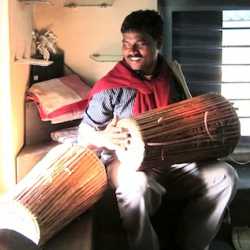
The performers of the Tribal/Folk Arts and Culture should continually upgrade their creative flair and operational skill so that they themselves can play a proactive role in bolstering the foundation and ensuring the sustainability of Tribal /Folks Arts and Culture. They should adopt a proactive stance in carrying the rich cultural legacy of India and proceed forward in pursuit of functional excellence.” – Evaluation Study of Tribal/Folk Arts and Culture in West Bengal, Orissa, Jharkhand, Chhatisgrah and Bihar. | Learn more >>
Search Worldcat.org for publications by reputed authors (select “Open Content/Open Access” for freely downloadable content)Search tips
Combine the name of any particular state, language or region with that of any tribal (Adivasi) community.
Ask a question that includes “tribal” or “Adivasi”, for instance: “Adivasi way of life better?” (or “tribal way of life worse?”)
Add keywords of special interest (music, poetry, dance just as health, sacred grove and biodiversity); learn about the rights of Scheduled Tribes such as the “Forest Rights Act” (FRA); and the United Nations “Declaration on the Rights of Indigenous Peoples”, “Universal Declaration of Human Rights”, “women’s rights”, or “children’s right to education”.
Specify any particular issue or news item (biodiversity, bonded labour and human trafficking, climate change, ecology, economic development, ethnobotany, ethnomedicine, global warming, hunter-gatherers in a particular region or state, prevention of rural poverty, water access).
“The great diversity of music in India is a direct manifestation of the diversity and fragmentation of the population in terms of race, religion, language, and other aspects of culture. […] The songs vary in detail, not only from one region to another, but also within a region among the different strata of society.” – NA Jairazbhoy in “Tribal, Folk and Devotional Music” >>
“Religion is a personal matter and should not be politicised.” – Invitation by the Bharat Jodo Abhiyan (BJA) – a civil society platform involving organisations from across 15 states – extended to all like-minded citizens “who take pride in our progressive, inclusive civilization and are committed to our constitutional values of fraternity, liberty, equality and justice” | TheWire (2 January 2024) >>
Find scholarly books, poetry and fiction relating to tribal culture – Indian publishers
List of sites covered by this Google SafeSearch engine
Combine the name of any particular state, language or region with that of any tribal (Adivasi) community.
Add keywords of special interest (music, poetry, dance just as health, sacred grove and biodiversity); learn about the rights of Scheduled Tribes such as the “Forest Rights Act” (FRA); and the United Nations “Declaration on the Rights of Indigenous Peoples”, “Universal Declaration of Human Rights”, “women’s rights”, or “children’s right to education”.
Ask a question that includes “tribal” or “Adivasi”, for instance: “Adivasi way of life better?” (or “tribal way of life worse?”)
Specify any particular issue or news item (biodiversity, bonded labour and human trafficking, climate change, ecology, economic development, ethnobotany, ethnomedicine, global warming, hunter-gatherers in a particular region or state, prevention of rural poverty, water access).
For official figures include “scheduled tribe ST” along with a union state or region: e.g. “Chhattisgarh ST community”, “Himalayan tribe”, “Scheduled tribe Tamil Nadu census”, “ST Kerala census”, “Particularly Vulnerable Tribal Group Jharkhand”, “PVTG Rajasthan”, “Adivasi ST Kerala”, “Adibasi ST West Bengal” etc.
SafeSearch browser tips
If your (mobile) browser fails to display “embedded” media contents, Google maps and SafeSearch windows
Try another browser like Firefox, Chrome or Safari available on your device
Ensure your favourite browser is up to date
Close your present browser
Check your browser and mobile (gsm) settings: e.g. permission for video or JavaScript (seen under Preferences >Security >Enable JavaSript)
Restart your computer (smartphone, tablet)
Reconnect to your wifi network or connect to a different one
On some iPhone models the following helps:
>Settings >Safari >scroll down to: SETTING FOR WEBSITES
Return to >Settings and disable “Request Desktop Website” again
Return to the post in Safari and “Reload”which should now display “embedded” contents as intended (with the convenience of browsing the mobile version on a small screen)
Note: similar solutions may also work with other mobile operating systems.