
The main festival celebrated of the Santal community (December-January) | Learn more >>
The Santals have no primordial books on their religion written by themselves. Their religion is based on oral traditions | Learn more >>

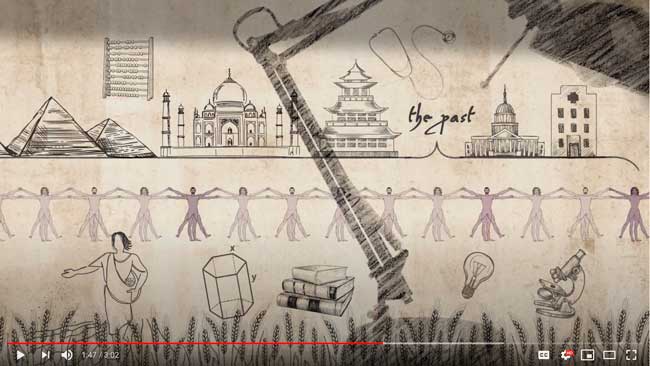
Watch “The Good Ancestor – The Legacies We Leave” (3 min.): An animation that explores the legacies we might leave for future generations >>
Links to some of the most important organisations, thinkers and doers that are leading the way and that have inspired the book The Good Ancestor by Roman Krznaric >>
Facts and figures: India’s biological, cultural and geographic diversity
Spread over 3,287,240 km2 and despite a total human population of over 1,210,000,000, India represents a wide spectrum of biological, cultural and geographic diversity. It has been identified as one of the top 12 global biodiversity hotspots and has 91 eco-cultural zones inhabited by 4,635 ethnic communities. India also has amongst the largest indigenous/tribal population, constituting 8.08% of the country’s population, representing 461 tribes. The term ‘Indigenous Peoples’ is not officially recognized in the country, instead the Constitution of India uses the term ‘Scheduled Tribes’. The total forest cover is estimated to be approximately 20% of the total area of the country. About 1,70,379 villages with a population of 10,674,334 inhabit areas in close proximity of forests.
Source: RECOGNITION AND SUPPORT OF ICCAs IN INDIA by Neema Pathak Broome and Tushar Dash, p. 4 | PDF-Repository
URL: https://kalpavriksh.org/wp-content/uploads/2021/01/IndiaICCARecognition_Final_SEPT2012-as-published.pdf
Date Visited: 10 March 2025