Nearly half of India’s 1.2 billion people have no toilet at home, but more people own a mobile phone, according to the latest census data.
Only 46.9% of the 246.6 million households have lavatories while 49.8% defecate in the open. The remaining 3.2% use public toilets. […]
About 77% of homes in the eastern state of Jharkhand have no toilet facilities, while the figure is 76.6% for Orissa and 75.8% in Bihar. All three are among India’s poorest states with huge populations which live on less than a dollar a day. In Jammu & Kashmir 8.9% of households still have their latrines emptied by manual scavengers.
“Open defecation continues to be a big concern for the country as almost half of the population do it,” Registrar General and Census Commissioner C Chandramouli said while releasing the latest data. […]
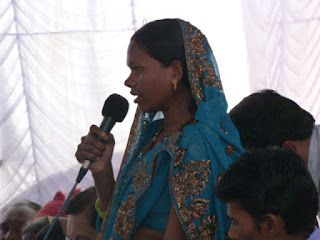
A union minister had recently said women in rural areas demand mobile phones, not toilets. This was vigorously denied by a 20-year-old tribal woman from Madhya Pradesh Anita Narre. “A toilet is more significant in the life of a woman than a mobile because the former gives them dignity”, she said. Anita Narre grabbed the international headlines at the beginning of the year when she was awarded for leading a “sanitation revolution”. Two days after her marriage in 2011 she left her in-laws house and refused to return until they had built a toilet.
Source: India census: more people have a mobile phone than a household toilet | Sanitation Updates
Address : http://sanitationupdates.wordpress.com/2012/03/16/india-census-more-people-have-a-mobile-phone-than-a-household-toilet/
Date Visited: Thu Apr 05 2012 14:11:03 GMT+0200 (CEST)
[Bold typeface added above for emphasis]
Context | Health care for communities identified as “poorest of poor” (PVTGs)
India is designated as the melting pot of so many ethnic groups dwelling at the same time under the common umbrella of a unified nation. Among these varied ethnic groups, some of them have been categorized under article 342 (1) of the constitution and have been labelled as Scheduled Tribe. In the post independent scenario, several schemes for upliftment of STs were run by the government but it was found that all these groups did not come up to the same level of development. Some of them were at much lower strata than others. Thus, in order to ensure the development of these communities, they were, for the first time in 1975-76 (during 5th Five-year plan) and thereafter-in 1993, identified as poorest of poor among the STs and were designated as Primitive Tribal Groups and thereafter constitution of India renamed and declared as Particularly Vulnerable Tribal Groups (PVTGs). Out of the 75 particularly vulnerable tribal groups, 13 are residing in Odisha; they are becoming increasing vulnerable due to loss of their customary habitat. The health troubles of rural areas especially in the tribal areas need a unique concentration, because the tribal people have typical health problem.
Source: 2019 PhD thesis (Abstract) by Jayanta Kumar Nayak titled “Health Seeking Behaviour and Health Care Services among the Hill Kharia Mayurbhanj District Odisha”, Department of Anthropology, Central University of Orissa
URL: http://hdl.handle.net/10603/257651
Date Visited: 21 May 2025