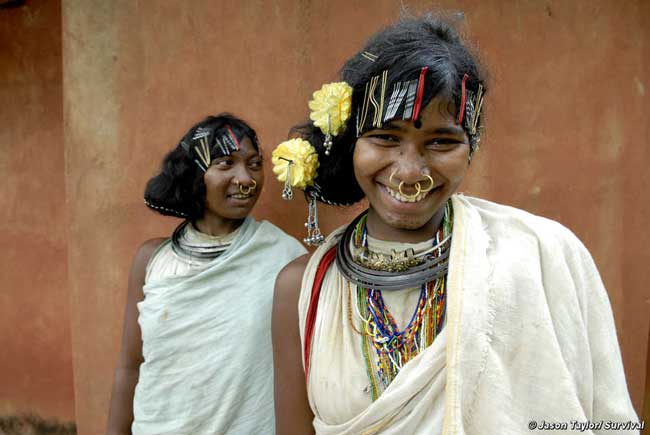
Photo © Survival International
There is huge potential among tribal children and our state has been promoting their talents in fields of art, culture, sports and education. – Chief minister Naveen Patnaik (The Times of India, 21 December 2015)
Source: Odisha government to fund education of tribal students in elite schools – Times of India
Address: https://timesofindia.indiatimes.com/india/Odisha-government-to-fund-education-of-tribal-students-in-elite-schools/articleshow/50268960.cms
Date Visited: 6 August 2016
The village population is solely of the Juang scheduled tribe, one of India’s ancient tribes, declared ‘particularly vulnerable’ by the government. […]
There are an estimated 10,000 members of the Juang tribe left, mostly living in the forested hills of Jajpur and adjoining Keonjhar. They have no rights over their beloved forest and they can hardly claim any right over the minerals. Should they be left to slowly perish of hunger and disease even as the country becomes a superpower?
Source: “How malnutrition is killing kids of a mineral-rich Odisha tribal village” by Subodh Varma, Times of India, 9 July 2016
Address: https://timesofindia.indiatimes.com/city/bhubaneswar/How-malnutrition-is-killing-kids-of-a-mineral-rich-Odisha-tribal-village/articleshow/53125313.cms
Date Visited: 11 September 2016
Context | Health care for communities identified as “poorest of poor” (PVTGs)
India is designated as the melting pot of so many ethnic groups dwelling at the same time under the common umbrella of a unified nation. Among these varied ethnic groups, some of them have been categorized under article 342 (1) of the constitution and have been labelled as Scheduled Tribe. In the post independent scenario, several schemes for upliftment of STs were run by the government but it was found that all these groups did not come up to the same level of development. Some of them were at much lower strata than others. Thus, in order to ensure the development of these communities, they were, for the first time in 1975-76 (during 5th Five-year plan) and thereafter-in 1993, identified as poorest of poor among the STs and were designated as Primitive Tribal Groups and thereafter constitution of India renamed and declared as Particularly Vulnerable Tribal Groups (PVTGs). Out of the 75 particularly vulnerable tribal groups, 13 are residing in Odisha; they are becoming increasing vulnerable due to loss of their customary habitat. The health troubles of rural areas especially in the tribal areas need a unique concentration, because the tribal people have typical health problem.
Source: 2019 PhD thesis (Abstract) by Jayanta Kumar Nayak titled “Health Seeking Behaviour and Health Care Services among the Hill Kharia Mayurbhanj District Odisha”, Department of Anthropology, Central University of Orissa
URL: http://hdl.handle.net/10603/257651
Date Visited: 21 May 2025
Learn more about Anganwadi schools >>
Norway- India Partnership Initiative (NIPI)
Projects » External Aided Projects
The Government of Orissa is pleased to announce the launch of the Norway-India Partnership Initiative (NIPI) for promoting child health under National Rural Health Mission in the State of Orissa. A Memorandum of Agreement has been signed on 13th of December, 2007 towards this.
The Norway- India Partnership Initiative is an outcome of commitment by the Hon’ able Prime Minister of Norway and the Hon’ able Prime Minister of India, focusing on the issue of reducing child mortality and improving child health to attain the Millennium Development Goal 4 by the year 2015. Norway has contributed USD 80 million over five years for this purpose to five states of Orissa, Bihar, Madhya Pradesh, Rajasthan and Uttar Pradesh. These States together constitute 40 percent of India’s population and contribute almost 60% of child deaths in India. […]
The Government of Orissa is committed to support this enthusiastic initiative to realize its vision to improve the child health status in Orissa and India.
Source: External Aided Projects | Department of Health & Family Welfare, Government of Orissa
Address: https://health.odisha.gov.in/External_Aided_Projects.asp?GL=5
Date Visited: Sat Aug 06 2016 13:44:50 GMT+0200 (CEST)
Support strengthening
Bhubaneswar, dated the 12th Jan 2013:UNICEF Country programme for 2013-2017 aims to advance the “rights of children, adolescents and women to survival, growth, development, participation and protection by reducing inequities based on cast, ethnicity, gender, poverty, region or religion”. Accordingly UNICEF would work in cooperation with Odisha Health & Family Welfare Department and contribute towards achievement of NRHM goal related to reduction of infant mortality and maternal mortality in Odisha by 2017. They will also cooperate towards achievement of Millennium Development Goals 4,5 and 6 in Odisha by 2015 and sustainable Development Goals beyond 2015 . […]
Source: NewsUNICEF.pdf
Address: https://www.odisha.gov.in/samachar/2013/Jan/data/12-01-2012/NewsUNICEF.pdf
Date Visited: Sat Aug 06 2016 13:40:43 GMT+0200 (CEST)
“It was assumed that tribal people have same health problems, similar needs and hence the uniform national pattern of rural health care would be applicable to them as well, albeit with some alteration in population: provider ratio. The different terrain and environment in which they live, different social systems, different culture and hence different health care needs were not addressed.” – Abhay Bang in Report of the Expert Committee on Tribal Health >>
A history of neglect
Odisha has 62 tribes, the highest number among all States and Union Territories in the country, accounting for 22.85 per cent of the total population as per 2011 census. As many as 13 of these tribes have been identified as Particularly Vulnerable Tribal Groups (PVTGs), living in over 500 habitations of the State but mostly in hamlets inside the forested hills across Odisha. The Juang tribe is one of the PVTGs that belong to the Munda ethnic group and live in Keonjhar, Dhenkanal, Angul and Jajpur districts of Odisha and speak the Juang language, which is accepted as a branch of the greater Austroasiatic language family. Those who come down the hills at regular intervals have picked up Odia.
It was to bring the Juangs into the mainstream that the Juang Development Agency (JDA) was established in 1975, with its headquarters in Gonasika Hills in Keonjhar district. Even after four decades have elapsed, the agency has not been able to go beyond the Juangs of Keonjhar, operating in 35 villages in six gram panchayats of Banspal block of Keonjhar. In fact, around 20 more villages in that block are yet to be covered. Many other Juang-dominated villages in Harichandanpur block of Keonjhar, Kankadahad block of Dhenkanal have remained outside the purview of the JDA all these decades. As do the hamlets on the Nagada hills. They are inaccessible by road — there is only one way to get there, and that is by foot.
The tragedy at Nagada involving the Juang tribe exposes the government’s apathy towards the PVTGs, but this is not for the first time that malnutrition-related deaths have stalked the tribal children. […]
After Odisha Women and Child Development Minister Usha Devi’s comment that the Juangs lack awareness attracted criticism from the public and the Opposition, the State administration is working overtime to build roads to Nagada using Integrated Action Plan funds by involving the Forest and Rural Development departments. […]
Source: Prafulla Das on The lost tribe of Odisha due to acute malnutrition-related diseases – The Hindu
Address: https://www.thehindu.com/opinion/op-ed/prafulla-das-on-the-lost-tribe-of-odisha-due-to-acute-malnutritionrelated-diseases/article8949433.ece
Date Visited: Sat Aug 06 2016 13:28:12 GMT+0200 (CEST)
[Bold typeface added above for emphasis]
Up-to-date reports by Indian experts and journalists
Search tips
Combine the name of any particular state, language or region with that of any tribal (Adivasi) community.
Add keywords of special interest (music, poetry, dance just as health, sacred grove and biodiversity); learn about the rights of Scheduled Tribes such as the “Forest Rights Act” (FRA); and the United Nations “Declaration on the Rights of Indigenous Peoples”, “Universal Declaration of Human Rights”, “women’s rights”, or “children’s right to education”.
Ask a question that includes “tribal” or “Adivasi”, for instance: “Adivasi way of life better?” (or “tribal way of life worse?”)
Specify any particular issue or news item (biodiversity, bonded labour and human trafficking, climate change, ecology, economic development, ethnobotany, ethnomedicine, global warming, hunter-gatherers in a particular region or state, prevention of rural poverty, water access).
For official figures include “scheduled tribe ST” along with a union state or region: e.g. “Chhattisgarh ST community”, “Himalayan tribe”, “Scheduled tribe Tamil Nadu census”, “ST Kerala census”, “Particularly Vulnerable Tribal Group Jharkhand”, “PVTG Rajasthan”, “Adivasi ST Kerala”, “Adibasi ST West Bengal” etc.
SafeSearch browser tips
If your (mobile) browser fails to display “embedded” media contents, Google maps and SafeSearch windows
Try another browser like Firefox, Chrome or Safari available on your device
Ensure your favourite browser is up to date
Close your present browser
Check your browser and mobile (gsm) settings:
e.g. permission for video or JavaScript
(seen under Preferences >Security >Enable JavaSript)
Restart your computer (smartphone, tablet)
Reconnect to your wifi network or connect to a different one
On some iPhone models the following helps:
>Settings >Safari >scroll down to:
SETTING FOR WEBSITES
Enable “Request Desktop Website” (All Websites) temporarily
Return to the map-post in Safari and “Reload”
Return to >Settings and disable “Request Desktop Website” again
Return to the post in Safari and “Reload”which should now display “embedded” contents as intended (with the convenience of browsing the mobile version on a small screen)
Note: similar solutions may also work with other mobile operating systems.
List of websites covered by this Google custom search engine
Academia.edu (platform for academics to share research papers) – www.academia.edu
Archive.org – https://archive.org
Centre for Science and Environment – https://www.cseindia.org
Current Conservation – https://www.currentconservation.org
Development and Cooperation (D+C) https://www.dandc.eu
Down To Earth (India) – www.downtoearth.org.in
India Environment Portal – www.indiaenvironmentportal.org.in
Harnessing Nature Magazine – https://harnessingnature.online
Mongabay-India – https://india.mongabay.com
M S Swaminathan Research Foundation – www.mssrf.org
Navdanya (protecting India’s biodiversity based food heritage) – https://navdanya.org
People’s Archive of Rural India – https://ruralindiaonline.org/
Third World Network (Penang, Malaysia) – https://twn.my
The Shola Trust (nature conservation in the Nilgiri region) – www.thesholatrust.org
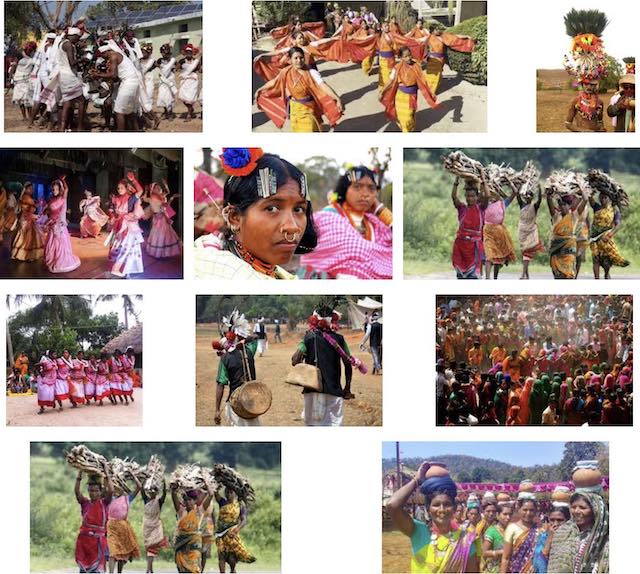
Indian online periodicals and platforms | Images view >>
~ ~ ~
Personalize your CustomSearch by combining other search words >>
(e.g. name of a tribal community and region, a craft, or dance and puppetry)
Research: explore PhD theses from all over India
Shodhganga (Open Access)
Tips | Interactive map
For details and hyperlinks, click on the button seen on the left top of this map.
Scroll and click on one of the markers for information of special interest.
Explore India’s tribal cultural heritage with another interactive map >>