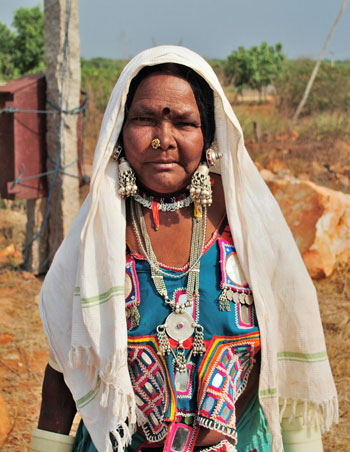
Categories: Lambadi People Rajput women >>

LAMBANIS: ORIGIN AND SOCIO CULTURAL PROFILE
By Dr. K. RamalingareddyORIGIN OF LAMBANIS
India is a land of castes and tribes. According to an estimate there arc about 427 tribal groups in the Country (Roy Burman, 1971:2). The Anthropological Survey (1967) has estimated the number at 314 considering a number of tribes to be the constituents of a group of tribes designated by a common name such as the Gonds, the Bhils, etc. In 1950, the number of scheduled tribes was 212. This number increased in 1956 with the revised list. All this gave rise to fluctuating figures of tribal communities and the tribal population.
According to Majumdar “Tribe is ordinarily an endogenous unit, the members of which confine their marriage within the tribe. Several clans constitute a tribe….” (1963). Thus the characteristic features of a tribal group are that the members of the group not only live together, speak the same dialect but also identify themselves with one common originator.
Some of the distinctive identity marks, which act as the community’s boundary-maintaining means and mechanisms are:
(1) a common name; Lambani or Banjara, (2) endogamy; (3) distinctive dress and ornamentation of their women (4) Lambani dialect, (5) their exclusive separate settlements, (6) a strong sense of clannishness, (7) specific religious and value clusters. (Halber, B.G.: 1986:217).
Among the numerous tribal groups in our country a tribe which is known for its colourful dress is that of Lambani tribal community. These people are also called as Banjara and Sukali. In different states they are known by different names […]
With a view to help the different caste and tribal communities to overcome their backwardness in various spheres of lives, our governments have grouped them as scheduled castes, scheduled tribes, de-notified tribes, other backward classes etc. The Lambani community in the states of Bihar, Orissa, West Bengal, Andhra Pradesh and Gujarat is considered as a scheduled tribe while in the state of Delhi, Himachal Pradesh, Rajasthan, Karnataka and Kerala they have been considered under the category of de-notified tribes and in other states as Other Backward Classes. (Khandoba. 1991, 20-21). From the sociological and anthropological points of view, the Lambanis are a tribe and hence they should be considered under scheduled tribe category. […]
Even though this tribal community is known by different names in different parts of the country, the terms Lambani, Banjara and Sukali are most frequently used ones in the regions wherever they live:
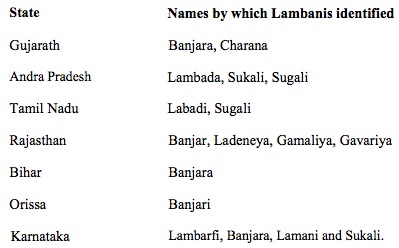
Source: by email courtesy Dr. K. Ramalingareddy (24 July 2018)
[Bold typeface added above for emphasis]
Read the full paper with author’s contact details
“Casteism is the investment in keeping the hierarchy as it is in order to maintain your own ranking, advantage, privilege, or to elevate yourself above others or keep others beneath you.” – Book review quoting Caste: The Origins of Our Discontents by Isabel Wilkerson
“Two prominent figures who have significantly contributed to this discourse are Mahatma Gandhi, Father of the Nation, and Bhimrao Ramji Ambedkar, Father of the Constitution. The two stalwarts of Indian politics, while revered equally by the public, had contrasting views on the caste system. […] And yet, despite their differences, they developed an understanding to work for the betterment of the marginalised.” – Rishabh Sharma in “How Ambedkar and Gandhi’s contrasting views paved way for caste reservation” (India Today, 6 October 2023) | Learn more >>
Up-to-date reports by Indian journalists and commentators